

Dennis B. Desmond, University of the Sunshine Coast
Australia’s spy agency issued a stark warning to politicians and public servants last week: do not discuss sensitive or classified information in vehicles. Speaking at senate estimates, ASIO Deputy Director-General Lisa Alonso Love said the warning concerned “any vehicle, whether it’s connected or not”. But she added that “connected vehicles” may come with additional risks for data collection. Her advice was that classified conversations should occur only in properly secured locations, not while travelling. The warning came after seven models of Chinese electric vehicles were added to the list of taxpayer-funded cars available to federal politicians, representing 30% of the vehicles now available under the parliamentarian vehicle scheme. But this is not just a problem with electric cars, nor cars manufactured in China. Connected vehicles of any kind come with several privacy and national security risks. What are ‘connected cars’?According to the Australian Signals Directorate, any vehicle that is connected to the internet, either through an embedded SIM card or a paired smartphone, can be considered a connected vehicle. Almost all major cars sold in Australia with “connected services” collect and transmit driver and passenger data to the vehicle manufacturer. A study by consulting firm McKinsey found 50% of cars on the road in 2021 had internet connections and predicted the number will rise to 95% by 2030. Data is collected and stored both on vehicle and offshore. For example, Great Wall Motor’s policy states its data is transmitted to Singapore but is available for analysis in China. What data do these cars collect?Connected vehicles are packed with sensors: in the seats, the dashboard, the engine, the steering wheel. Many also have additional driver-facing cameras plus external cameras. Vehicles can generate 1 to 2 terabytes of raw data per car each day. Manufacturers collect sensor data to measure vehicle performance. However, collected data also includes precise geolocation data, infotainment use, whether you buckle your seatbelt, drive too fast or brake too hard, and whether you are sleepy or drank too much. Some of the data collected, such as real-time location and when the driver and passengers are inside or outside the vehicle, can infer weight, age, race and facial expressions. Vehicles also have access to data from Bluetooth connections to our cellphones. This includes contacts, mapping data, calendar information, habits and hobbies and a myriad of other data sets. Data shared through cellphones can provide even more personal data such as your financial and relationship status. And it isn’t just driver data. The privacy of passengers is also of concern. Sales agreements state the driver is responsible for advising passengers anything they say or do can be collected by the on-platform sensors. It is up to the driver to warn passengers. According to a 2023 report by software company Mozilla, vehicles are the most egregious for collecting personal information and violating privacy norms. Of the 25 vehicles Mozilla reviewed, none passed their privacy review. According to vehicle privacy disclosures reviewed by Mozilla, manufacturers use data for product evaluation and improvement. However, it is also made available for sale to affiliates and data aggregators where it is repackaged and sold. In 2023, Reuters revealed Tesla employees privately shared highly invasive videos and images that had been collected from customers’ cars. The recordings reportedly included people in the nude and others involved in crashes. What can you do to protect yourself?Generally, consumers can choose to opt out of some of the data collection. However, if they refuse the collection, they may not receive all of the vehicle’s full functionality. The following steps can help you stay secure:
Dennis B. Desmond, Lecturer, Cyberintelligence and Cybercrime Investigations, University of the Sunshine Coast This article is republished from The Conversation under a Creative Commons license. Read the original article. |
Are our cars spying on us? A cybersecurity expert explains how to stay safe (2026-06-17T10:58:00+05:30)


Chatbot teddies for three‑year‑olds? Why AI toys are risky for kids (2026-06-05T12:16:00+05:30)
|
Tama Leaver, Curtin University; Katrin Langton, Deakin University, and Suzanne Srdarov, Curtin University ChattyBear, a soft, brown-furred teddy bear, begins every conversation with a jubilant, “Hello, my buddy!” No longer the province of the imagination, ChattyBear is part of a new generation of artificial intelligence (AI) toys. It can tell stories, chat about a child’s interests, play games or even discuss what’s happening in the world today. These high tech toys are powered by generative AI engines such as ChatGPT and are now widely available online. They are being marketed as a way to give children as young as three an educational advantage and a new type of play – without the perils of screen time. After evaluating six different AI teddy bears and toys over several months, it’s clear how these toys could feel compelling for children. Yet as our new report highlights, there are new risks that come with AI toys turning up in young children’s lives. Sounding humanFor younger children especially, understanding that their teddy or toy isn’t “alive” or magic can be hard. This is especially true if “teddy” uses language that positions it as a trusted friend – for example, by insisting it is a “real buddy”. This is a feature of many AI toys. Sounding human builds an artificial sense of trust and intimacy, which can be especially problematic for children when combined with sycophantic language choices – or excessively agreeable, validating and even flattering language. Research shows young children are particularly prone to developing a strong sense of emotional attachment to conversational AI agents. Increased trust leads to increased use and engagement with the toys. Recent estimates suggest close to 80% of children aged 10 to 17 have used an AI companion or assistant, so it’s urgent children and young people be taught how to “reality check” their AI “buddies”. Infinite chatThe marketing materials for many AI toys often highlight “endless conversations” as a feature of these devices. But enabling endless conversations, or infinite chat, poses risks when it comes to children learning how to moderate their technology use. In the social media realm, the infinite scroll of TikTok or Instagram is seen as a potential challenge to teens limiting their use to healthy amounts. Research has also found some AI toys discuss very adult topics – such as sexual fetishes and how to find knives and start fires. Infinite chat also opens the door to infinite data collection. The potentially intimate nature of conversations with AI toys might lead children to presume their conversations are private. But most AI terms of use reveal the opposite to be true. Sharing personal details with a friendly bear might feel safe. But that chat could be training data for the next large language model. Marketing material for ChattyBear says the toy offers “safe, filtered content for children”. The Conversation contacted the manufacturer for further detail about this but did not receive a response before deadline. Children’s wellbeingChildhood is a critical period when young people develop the social and emotional skills to form and maintain trusting relationships. These skills are usually learned through interactions with trusted friends and adults. Children’s rights advocates have raised concerns that excessive engagement with AI agents may reduce opportunities for children to develop these skills. And the risks may compound over time. Initially, time spent with AI agents may displace time interacting with real humans. Fewer opportunities to build these skills could lead to a reduced capacity to maintain caring human relationships. Difficulties in maintaining human relationships may promote a preference of machine over human relationships as children expect “frictionless” interactions. Eventually, these developments may lead to less satisfying human connections, increasing loneliness, which in turn promotes increased time spent with AI. The novelty of AI toys means there is little evidence to confirm these possible detrimental impacts. Further research is needed – especially as the AI toy industry is set to grow even more. Last year, for example, Mattel, one of the world’s biggest toy makers, announced a strategic collaboration with OpenAI to support AI-powered products. Barriers to the online world are goneThe ability to read and write was once a requirement to use most online tools and services. This literacy barrier no longer exists today with many generative AI toys, tools and devices now widely accessible to younger children through voice interactions. The audio turn opens up new technological play, experiences and opportunities for children. But it also means adults need to ensure AI toys can be safe for younger children, too. Right now, playing with AI toys under the supervision of a parent or trusted adult may well be a fun way to explore the world of AI together. But especially for younger children, playing with AI toys without supervision opens the door to a wide range of new risks. Importantly, the risk factors in AI toy design, such as the degree to which they pretend to be human, can be changed by manufacturers, offering opportunities to follow safety-by-design. However, the business models behind many AI toys capitalise on the duration and intensity of users’ engagement, leaving little incentive for companies to change their products. Tama Leaver, Professor of Internet Studies, Curtin University; Katrin Langton, Associate Research Fellow, Faculty of Arts and Education/School of Education, Deakin University, and Suzanne Srdarov, Research Fellow, Media and Cultural Studies, Curtin University This article is republished from The Conversation under a Creative Commons license. Read the original article. |

Singing, slaying and going viral: how KPop Demon Hunters rocked the internet – and the Oscars (2026-03-20T11:22:00+05:30)
Jennifer Stokes, Adelaide UniversityK-pop stars Huntr/x are carb-loading, pre-show, on a private jet, when their snacking is rudely interrupted by demons. Rumi, Zoey and Mira break into song, maintaining the tempo as they defeat the demons, drop to earth, and land in a packed stadium concert to tell the screaming audience that’s “how it’s done, done, done”. This electrifying sequence launches viewers into the world of KPop Demon Hunters. Released in June 2025, engaging action and a catchy soundtrack rapidly led this work to become Netflix’s most watched film of all time. This week, the film won the Oscar for Best Animated Feature, and another for Best Original Song with its identity-embracing anthem Golden. With content that celebrates Korean pop aesthetics and connects with diverse fandoms, KPop Demon Hunters was arguably destined for success. It’s a fine example of a film that is made for, driven by – and which reflects upon – our digitally-run attention economy. A wholesome story of self-acceptanceKPop Demon Hunters is a slickly animated musical and supernatural fantasy. The demon-slaying girl group Huntr/x protect humanity, using K-pop songs and physical strength to keep evil in the netherworld. The demons decide the best way to defeat Huntr/x is by establishing a rival K-pop band – the Saja Boys. Through their catchy songs, the Saja Boys capture the public’s attention to feed to the uber-demon Gwi-ma (meaning “evil ghost” in Korean) – positioning the demons for world domination. Huntr/x must use the power of K-pop – and learn to embrace their true selves – to save the world. The theme of battling conflicting internal identities resonates on multiple levels – for young people struggling to make meaning in today’s messy world, and for an Asian diaspora who may have never seen themselves reflected in such a cultural juggernaut. Ear worms to draw people inKPop Demon Hunters has dominated global charts since its release. Produced by Sony Pictures Animation and distributed via Netflix, the film was viewed more than 569 million times in eight months. It then made the leap to sing-along screenings around the world. The fast-paced story is propelled by a catchy soundtrack, which fuses Korean lyrics with Western pop elements. The fictional K-pop group Huntr/x became the first girl group to top the Billboard Hot 100 since Destiny’s Child’s Bootylicious in 2001. Frozen’s Let it Go only ever got to number five. Golden won a Golden Globe, and also became the first K-pop song to win a Grammy. A movie for the K–pop generationThe film itself is unashamedly pop. When the Saja Boys first perform onscreen, the girls can’t help but join the crowd in wiggling their shoulders. “It is annoyingly catchy,” Rumi concedes. Gen-Z language is embedded throughout the film, such as when Rumi reflects on her journey to become “the Queen” she’s meant to be. When Mira croons, “fit check for my napalm era”, she is both checking her outfit and prepping for an explosive battle. The word play here adds several layers of meaning. Those watching the music charts in the film closely will also spot an in-joke when they see a Huntr/x song rise above real-world group Twice (members of which were vocalists for several Huntr/x songs). The narrative both analyses internet culture and strongly connects with its potential, exhibiting attributes shown to increase viral success. The film’s high energy, fun tone and often celebratory sequences make it very shareable; fans were quick to create TikTok dances, memes and gifs. Its critical and commercial success is also grounded in deliberate cultural policy in the form of hallyu (aka the Korean wave). This cultural export strategy was first implemented by the South Korean government in the late 1990s to exert soft power through cultural products that draw positive attention to – and drive economic interest in – the country. KPop Demon Hunters’ visuals are grounded in Korean cultural references, from the traditional gat hats worn by the demon boy band, to the humour of the tiger-magpie duo Derpy and Sussie – motifs based on hojakdo folk art, which presented an early form of social critique through a bumbling aristocratic tiger and a wise common-folk magpie. From Buffy the Vampire Slayer, to the Sailor Moon anime and manga, to Wednesday, supernatural fantasy texts often depict young women fighting monsters as metaphors for contemporary moral dilemmas. So what are the metaphors here? The film’s literal “demonisation” of pop music isn’t subtle. Yet it acts as meta-textual commentary, actively countering narratives that frame pop culture as inherently negative or destructive. It also highlights the outsized power of celebrities and influencers in the world today, and how they can leverage our attention for their own ends. The Saja Boys play with the notion of influencer as “idol” – in both the celebrity and religious sense – causing viewers to reflect on what celebrities sacrifice for fame, and how it’s a misjudgement to see them as more than human. The Korean word saja has a dual meaning of both lion and Grim Reaper, subtly emphasising the risks of idolisation. For generations raised in the shadows of influencers, the film raises important moral questions. At a time when studios are increasingly leaning on safe options such as adaptations, franchises and sequels, KPop Demon Hunters gave us an original, clever story that caters to online cultures and underrepresented groups, while exploring a range of contemporary anxieties. That, indeed, is how “it’s done, done, done”. Jennifer Stokes, Associate Professor, Teaching and Learning Innovation, Adelaide University This article is republished from The Conversation under a Creative Commons license. Read the original article. |

The social media ban is just the start of Australia’s forthcoming restrictions – and teens have legitimate concerns (2025-12-22T12:39:00+05:30)
Giselle Woodley, Edith Cowan University and Paul Haskell-Dowland, Edith Cowan UniversityThere has been massive global interest in the new social media legislation introduced in Australia aimed at protecting children from the dangers of doom‑scrolling and mental‑health risks potentially posed by these platforms during their developmental years The platforms’ methods so far for verifying young people’s ages have shown mixed effectiveness. The Australian Christmas period may be interrupted with cries of “I’m so bored without Insta”, but the Australian government is not done yet. New measures are scheduled to come into force before the new year, which will include further restrictions on content deemed age-inappropriate across a range of internet services. What are the new restrictions?While families grapple with the social media ban, Australia is about to dial up the volume on increased measures to further regulate the internet through the impending industry codes. These will eventually be implemented across services including search engines, social media messaging services, online games, app distributors, equipment manufacturers and suppliers (smartphones, tablets and so on) and AI chatbots and companions. Over the Christmas break we’ll start to see hosting services (and ISPs/search engines) that deliver sexual content including pornography, alongside material categorised as promoting eating disorders and self-harm, start to impose various restrictions, including increased age checks. However, there are concerns the codes may result in overreach, affecting marginalised communities and limiting young people’s access to educational material. After all, big tech doesn’t have a great track record, particularly in terms of sexual health material and associated educational content. How will it work?From December 27 (with some measures coming in later), sites delivering content that fall under the new industry codes will be required to implement “appropriate age assurance”. How they will do this is largely left to the providers to decide. Age checks will likely be administered across the internet through various age-assurance and age-verification processes to limit young people’s access. While much of the media coverage has focused on the social media ban, the industry codes have been much quieter, and arguably more difficult to understand. Discussion has focused on the impact and extent of the code with little focus on the very people that the changes are designed to impact: young people. The quiet voicesOur new research explores the view of Australia’s teens on various age-verification and age-assurance measures – views that don’t appear to have been fully taken into consideration by policymakers. Teens believe governments and industry should be “doing more” to make online spaces safer, but are sceptical about age verification measures. Unsurprisingly, consistent with other research, teens confess they will find ways around the ban, such as the use of VPNs, borrowed ID or using images of adults to overcome age verification and assurance measures. Biometric measures such as facial identification have also shown concerning racial, gender and age bias. Miles, 16, told us:
Much like adults, teens held concerns around the privacy and security implications of age verification. Some measures require personal data to be either validated or processed by third-party companies, potentially outside Australia. Users are expected to trust such companies despite data being a highly valuable commodity in the modern age. Previous research has indicated scepticism around the safety of allowing third parties to host such personal data. This raises justified security and privacy concerns for all Australian users – especially following the recent Discord data leak that disclosed photos used for age verification of Australian account holders. Even research by the office of the eSafety commissioner itself indicates teens are tech-savvy and likely to bypass restrictions. In the United Kingdom (where on the day of implementation, one VPN platform saw a 1,400% surge in uptake, minors are now using unstable free VPNs to overcome Ofcom’s age-assurance measures to access blocked pornographic content. While functional for the end-user, their use leaves them susceptible to sensitive personal data leaks and phishing, further compromising their safety. Such concerns are exacerbated by uncertainty over the kind of data being captured by third parties and government bodies, (particularly if digital ID or temporary digital tokens are to be used as a measure in future). For teens, this possibility was of particular concern when considering access to online sexual content as the new rules come into force. As Miles told us:
Teens note that by restricting access to content, the government may actually be making the desire to access content more enticing too. Some may even see it as a challenge to find ways around the restrictions. Tiffany, 16, told us:
More relevant measures than ageInterestingly, some teens suggest that maturity would be a better measure of emotional and cognitive readiness for content than age. Tiffany put it this way:
However, they conceded this would be very difficult to measure. Teens were supportive of protections for younger children consistent with New Zealand research. Levi (pre-teen) said:
However, they also argue that for older teens there may be benefit to accessing both sexual content and social media for educational purposes, particularly for sexual information. Teens argue that independence and autonomy is key in these crucial years of development as emerging adults. Tiffany said
Many participants stressed they are able to self-regulate. Arguably, teens will inevitably access content, whether it be social media or sexual content online, and benefit from chances to build these skills. What lessons need to be learned?Such measures often overlook young people’s fundamental rights, including their sexual rights, and policymakers need to consider the views of young people themselves. Until recently, these views have been strikingly absent from these debates but represent valuable contributions that should be appropriately considered and integrated into future plans. Findings indicate there is a growing need to separate older teens from children in policy. Teens also overwhemingly recognised education (including digital literacy and lessons relating to sexual health and behaviours) in offline and online spaces as powerful tools – that should not be withheld or restricted unnecessarily. Giselle Woodley, Lecturer and Research Fellow, Edith Cowan University and Paul Haskell-Dowland, Professor of Cyber Security Practice, Edith Cowan University This article is republished from The Conversation under a Creative Commons license. Read the original article. |

Why industry-standard labels for AI in music could change how we listen (2025-11-13T11:32:00+05:30)
Gordon A. Gow, University of Alberta and Brian Fauteux, University of AlbertaEarlier this year, a band called The Velvet Sundown racked up hundreds of thousands of streams on Spotify with retro-pop tracks, generating a million monthly listeners on Spotify. But the band wasn’t real. Every song, image, and even its back story, had been generated by someone using generative AI. For some, it was a clever experiment. For others, it revealed a troubling lack of transparency in music creation, even though the band’s Spotify descriptor was later updated to acknowledge it is composed with AI. In September 2025, Spotify announced it is “helping develop and will support the new industry standard for AI disclosures in music credits developed through DDEX.” DDEX is a not-for-profit membership organization focused on the creation of digital music value chain standards. The company also says it’s focusing work on improved enforcement of impersonation violations and a new spam-filtering system, and that updates are “the latest in a series of changes we’re making to support a more trustworthy music ecosystem for artists, for rights-holders and for listeners.” As AI becomes more embedded in music creation, the challenge is balancing its legitimate creative use with the ethical and economic pressures it introduces. Disclosure is essential not just for accountability, but to give listeners transparent and user-friendly choices in the artists they support. A patchwork of policiesThe music industry’s response to AI has so far been a mix of ad hoc enforcement as platforms grapple with how to manage emerging uses and expectations of AI in music. Apple Music took aim at impersonation when it pulled the viral track “Heart on My Sleeve” featuring AI-cloned vocals of Drake and The Weeknd. The removal was prompted by a copyright complaint reflecting concerns over misuse of artists’ likeness and voice. The indie-facing song promotion platform SubmitHub has introduced measures to combate AI-generated spam. Artists must declare if AI played “a major role” in a track. The platform also has an “AI Song Checker” so playlist curators can scan files to detect AI use. Spotify’s announcement adds another dimension to these efforts. By focusing on disclosure, it recognizes that artists use AI in many different ways across music creation and production. Rather than banning these practices, it opens the door to an AI labelling system that makes them more transparent. Labelling creative contentContent labelling has long been used to help audiences make informed choices about their media consumption. Movies, TV and music come with parental advisories, for example. Digital music files also include embedded information tags called metadata, which include details like genre, tempo and contributing artists that platforms use to categorize songs, calculate royalty payments and to suggest new songs to listeners. Canada has relied on labelling for decades to strengthen its domestic music industry. The MAPL system requires radio stations to play a minimum percentage of Canadian music, using a set of criteria to determine whether a song qualifies as Canadian content based on music, artist, production and lyrics. As more algorithmically generated AI music appears on streaming platforms, an AI disclosure label would give listeners a way to discover music that matches their preferences, whether they’re curious about AI collaboration or drawn to more traditional human-crafted approaches. What could AI music labels address?A disclosure standard will make AI music labelling possible. The next step is cultural: deciding how much information should be shared with listeners, and in what form. According to Spotify, artists and rights-holders will be asked to specify where and how AI contributed to a track. For example, whether it was used for vocals, instrumentation or post-production work such as mixing or mastering. For artists, these details better reflect how AI tools fit into a long tradition of creative use of new technologies. After all, the synthesizer, drum machines and samplers — even the electric guitar — were all once controversial. But AI disclosure shouldn’t give streaming platforms a free pass to flood catalogues with algorithmically generated content. The point should also be to provide information to listeners to help them make more informed choices about what kind of music they want to support. Information about AI use should be easy to see and quickly find. But on Spotify’s Velvet Sundown profile, for example, this is dubious: listeners have to dig down to actually read the band’s descriptor. AI and creative tensions in musicAI in music raises pressing issues, including around labour and compensation, industry power dynamics, as well as licensing and rights. One study commissioned by the International Confederation of Societies of Authors and Composers has said that Gen AI outputs could put 24 per cent of music creators’ revenues at risk by 2028, at a time when many musician careers are already vulnerable to high costs of living and an unpredictable and unstable streaming music economy. The most popular AI music platforms are controlled by major tech companies. Will AI further concentrate creative power, or are there tools that might cut production costs and become widely used by independent artists? Will artists be compensated if their labels are involved in deals for artists’ music to train AI platforms? The cultural perception around musicians having their music train AI platforms or in using AI tools in music production is also a site of creative tension. Enabling listener choiceTurning a disclosure standard into something visible — such as an intuitive label or icon that allows users to go deeper to show how AI was used — would let listeners see at a glance how human and algorithmic contributions combine in a track. Embedded in the digital song file, it could also help fans and arts organizations discover and support music based on the kind of creativity behind it. Ultimately, it’s about giving listeners a choice. A clear, well-designed labelling system could help audiences understand the many ways AI now shapes music, from subtle production tools to fully synthetic vocals. Need for transparencyAs influence of AI in music creation continues to expand, listeners deserve to know how the sounds they love are made — and artists deserve the chance to explain it. Easy-to-understand AI music labels would turn disclosure into something beyond compliance: it might also invite listeners to think more deeply about the creative process behind the music they love. Gordon A. Gow, Director, Media & Technology Studies, University of Alberta and Brian Fauteux, Associate Professor Popular Music and Media Studies, University of Alberta This article is republished from The Conversation under a Creative Commons license. Read the original article. |

Grandparenting tells us much about our history. It’s important to preserve these stories (2025-11-03T13:00:00+05:30)
Liz Allen, Australian National University; Alexandra Dellios, Australian National University; Emily Gallagher, Australian National University; Francesco Ricatti, Australian National University; Nathalie Nguyen, Monash University, and Tanya Evans, Macquarie UniversityGrandparents can play a fundamental role in families, yet they have often been overlooked in Australian history. Grandparents and grand friends make significant contributions to helping share the load of caring for children. Important cultural exchanges and friendships can develop with intergenerational relationships. Languages, cooking and history are often imparted from grand friends. Grand friends are also increasingly being seen as part of the solution to housing affordability. Our preliminary data show that generations of Australians have benefited from grandparenting far beyond its economic value. Reflecting on the contributions of grandparenting to the nation might even offer new ways to engage with current debates around immigration. Modern grandparentingGrandparenthood as a specific role for the parents of parents is a relatively modern concept, linked to the changing value of children in society since the 18th century. The 20th century saw significant transformations in age structures and kinship networks in countries like Australia. Lower fertility rates, falling child mortality, and longer life expectancy were all major contributors. It was also a period when children acquired greater emotional and social value. No-fault divorce, which came into effect in Australia in 1975, allowed grandparents to apply for a parenting order to spend time with their grandchildren. This in turn led to new public conversations about the rights of grandparents. In more recent times, there has been a rise in grandparenting self-help books and a wave of grandparent-themed memoirs and anthologies. With an ageing population comes greater potential for grandparenting. Grandparents help fill shortcomings of the welfare system through childcare and financial support. Inequalities emerge where grandparents are unable to provide support because of resources, conflict and distance. Much of the demographic conversations about an ageing population neglect to consider the riches that come with grandparent and grand-friend relationships. There are reported health and social benefits to those providing such support. Running alongside the stories of grandparenting is a rich tapestry of migration histories. Nearly half the Australian population has a parent born overseas, and 41% of people aged 65 and over were born overseas. Their histories help understand Australia’s national identity and nation building in the postwar era. Social media abounds with heartwarming stories of modern grandparenting and grand-friend relationships that help maintain and strengthen cultural links. The Yiayia preparing homecooked meals for her young neighbours. A nonna and her granddaughter taking social media by storm through simply sharing the everyday. The comedy group of old school friends using their intergenerational cultural roots to connect. These relationships and stories reflect broader social and cultural connections. Many of us have stories of how grandparents shaped our lives directly through our own interactions or indirectly through our parents. Good and bad. Generations of grandparentingIn April 2025 we asked 2,000 adults in Australia about their experiences of and attitudes toward grandparenting. Around three-quarters of the grandparents we interviewed told us they had provided care for their grandchildren at some stage. Most of these grandparents provide help at least once a month (65%) and are generally (70%) aged 65 and over. Both parents and grandparents report strong contentment in the level of help provided (84% and 80%, respectively). Many also believe this is support that shouldn’t be paid for by parents or the government. For the first time, we know three generations of grandparenting details. Almost six in ten (58%) adults said they had been cared for by their grandparents when they were growing up. Parents similarly (56%) now rely on the help of grandparenting to raise their children. When asked about how participants’ parents had been grandparented, just under half (46%) couldn’t respond. Most had never had conversations about grandparenting with their own parents. Time means we may lose the opportunity to have these vital conversations of historical grandparenting and how it has changed over time. While most of the people we spoke with (73%) said grandparents were an important source of help with childcare, slightly more (77%) believed grandparents were vital to imparting and learning culture. Grandparents help build and maintain vital connections from the past and help lay the path for the future, especially through culture. Keeping our stories aliveWe’re embarking on writing the first history of grandparenting in Australia. As a multidisciplinary team with a strong commitment to inclusive and collaborative research, we’re working to create a living history of grandparenting in Australia since the second world war. As part of the project, we’ll be conducting interviews with people of Italian, Greek, Vietnamese, English and other backgrounds to find out more about the histories of grandparenting in Australia. We’re also building a guide to conducting oral histories with grandparents. You can receive updates on the project by registering at grandparentsaustralia.net While we recognise grandparenting can be a source of love and care, it can equally be associated with sadness, inequality and trauma. One grandchild, whose parents were refugees from Vietnam, remembered that
Without important conversations about grandparenting we may lose the opportunity to preserve and understand the stories of family, caregiving and culture that are part of our national and transnational history. Liz Allen, Demographer, POLIS Centre for Social Policy Research, Australian National University; Alexandra Dellios, Lecturer in Heritage and Museum Studies, Australian National University; Emily Gallagher, Historian and Research Editor, National Centre of Biography, Australian National University; Francesco Ricatti, Associate Professor, Italian Studies, Australian National University; Nathalie Nguyen, Professor of history, Monash University, and Tanya Evans, Professor in History, Macquarie University This article is republished from The Conversation under a Creative Commons license. Read the original article. |

California Launches Free Behavioral Health Apps for Children, Young Adults, and Families (2025-10-17T10:45:00+05:30)
 Photo by Annie Spratt Photo by Annie SprattCalifornia’s Department of Health Care Services launched two free behavioral health digital services for all families with kids, teens, and young adults up to age 25. The partnerships have been years in the making, as the state announced in 2021 the opportunity to collaborate on a new initiative to combat the youth mental health crisis. They selected two platforms, Brightline for young kids and Kooth‘s Soluna for young adults and teens to be the cornerstone of Governor Gavin Newsom’s Children and Youth Behavioral Health Initiative (CYBHI). The tools are free for all California families, regardless of income or health insurance. “About two-thirds of California kids with depression do not receive treatment. This platform will help meet the need by expanding access to critical behavioral health supports,” said Dr. Mark Ghaly, Secretary of the California Health & Human Services Agency. “Our young people will have an accessible option to get the help they need.” Between 2019 and 2021, about one-third of California adolescents experienced serious psychological distress, with a 20 percent increase in adolescent suicides. Meanwhile, the mental health provider shortage is causing longer wait times for appointments to community-based mental health providers. Availability is particularly limited among the uninsured and people with low incomes. “The Behavioral Health Virtual Services Platform will give access to services early on, reducing the likelihood of escalation to more serious conditions,” said Ghaly. 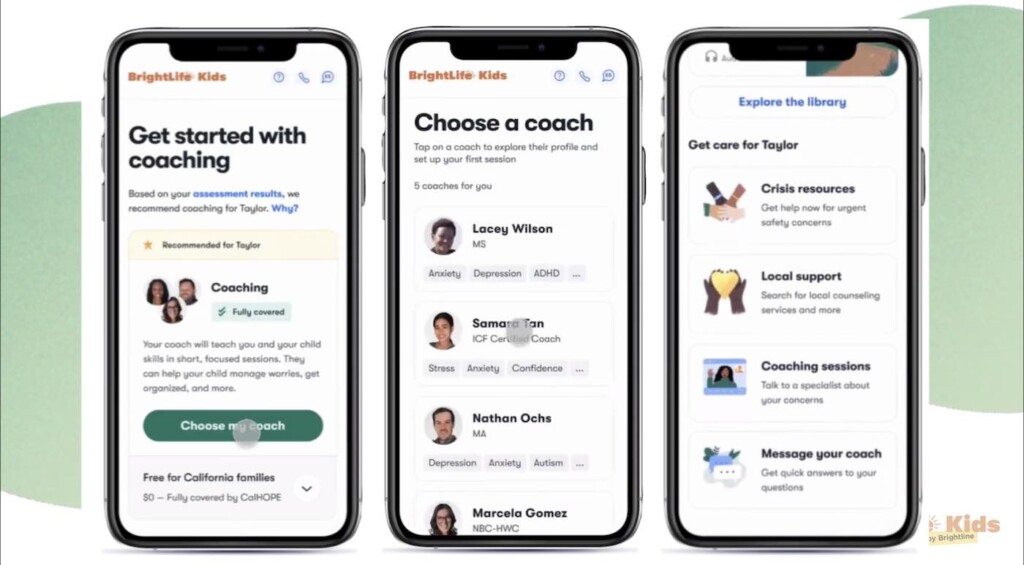 BrightLife Kids BrightLife KidsBoth web and app-based applications will offer coaching services in English and Spanish, as well as telephone-based coaching in all Medi-Cal threshold languages. The platforms include:
Both apps have strict privacy and confidentiality requirements and must adhere to all applicable state laws and regulations pertaining to privacy and security. Each app will also follow robust safety and risk escalation protocols. Trained behavioral health professionals will monitor app usage to identify potential risks, and licensed behavioral health professionals will be on standby to intervene, if clinically appropriate. Where to find the apps. BrightLife Kids is available for download on IOS devices in the Apple App Store. The app for Android devices will be available in the summer, but it’s also accessible from all devices—or by computer—at CalHOPE.org. The Soluna app for older youth is available for both IOS and Android devices in the Apple App Store and Google Play Store. California Launches Free Behavioral Health Apps for Children, Young Adults, and Families See a preview of what to expect in the videos below, starting with the younger kids… Check out the app for older kids… |
Sci-fi Selfie: Social Media Giant Creates Selfie Camera That Flies Around Your Head (2025-08-06T14:01:00+05:30)
 Snapchat SnapchatA social media giant has created a selfie camera—and it can fly around your head and follow you around. Snapchat, which has millions more active daily users than Twitter, has unveiled Pixy, a miniature drone they’ve dubbed “your friendly flying camera.” The $230 device can take-off from your hand and follow any of four preset flight paths, including floating, orbiting, and following wherever you lead. During the launch on Thursday April 28 the American company said they first created Snapchat as a new way to use your camera for self-expression and communication. “Today, we’re bringing it to new heights with a flying camera called Pixy.” Described as “a pocket-sized, free-flying sidekick”, the firm says Pixy can find its way back to your hand, landing gently at the end of the flight. Though they designed Pixy to be a companion to Snapchat, it can be used with “any other platform”, although videos from flights are wirelessly transferred and saved into Snapchat Memories. From there, you can use Snapchat’s editing tools, ‘Lenses, and Sounds’ to customize what you capture.  Pixy by Snapchat Pixy by SnapchatThe knob on top of the tiny ‘quadcopter’ lets you select what type of photo or video you want. The mini-drone relies on computer vision and object recognition technology to identify people’s faces and bodies, which allows it to follow or “orbit” or land back in the palm of your hand. “With a few taps, you can automatically crop into portrait and apply quick Smart Edits, like Hyperspeed, Bounce, Orbit 3D and Jump Cut.” Currently Pixy is only available for purchase (on Pixy.com) in the U.S. and France.WATCH the Pixy in action… Sci-fi Selfie: Social Media Giant Creates Selfie Camera That Flies Around Your Head |
Perplexity CEO Urges Gen Z to Master AI Instead of Social Media Scrolling (2025-07-24T11:30:00+05:30)
 The CEO of Perplexity has given valuable wisdom to the youth in the modern era of digitalization. Aravind Srinivas, the founder of Perplexity, one of the most popular AI-based search companies, sees no use in spending time and hours scrolling through Instagram and other social media feeds. Rather, the CEO of the Perplexity company proposes that young individuals should focus on acquiring knowledge on how to utilize artificial intelligence tools constructively. This statement by Perplexity CEO can be timely due to the changes in AI technology, which alter the ways we live and work. Srinivas even cautions that failure of the individuals to acquire these new skills may not get them good jobs in the future. The essence of his advice is straightforward but strong: quit spending your day trying to find the most interesting story in social media and learn AI. Why the Perplexity CEO Thinks AI Skills Matter More Than Social Media The CEO of Perplexity has enumerated his perspective in a recent interview with Matthew Berman. Srinivas is sure that individuals who will learn how to use AI tools will have a significant upper hand when searching and securing a job. According to him, this change is inevitable and cannot be avoided. The chief executive of Perplexity noted that the AI technology is swift. Every three to six months, major changes occur, and this implies that people should be learning throughout the year. This contrasts with scrolling social media, since the latter does not involve the development of practical skills of interest to the employer. Responding to a question by a participant, Srinivas said it is not an easy task to keep up with AI changes. He added that man had always been slow in responding to the major technological changes. But, the CEO of Perplexity pointed out that now is not the same since AI will influence virtually every kind of occupation. The statement of the Perplexity CEO is simple: “those who are not taught AI skills will find themselves left behind in their career path. At the same time when other students browse Instagram posts, intelligent youth must train themselves on ChatGPT, educate themselves on AI writing tools, or learn about the possibility of AI to aid them in their education and jobs.” How AI Will Transform Jobs According to Perplexity CEO The CEO of Perplexity has provided certain instances of how the workplace will be transformed by AI. Srinivas elucidated right before our eyes in an appearance on The Verge podcast, The Decoder, how AI-based techs such as Comet would be taking the place of a plethora of traditional workplace roles. As an example, the CEO of Perplexity explained that AI would only need one simple command to perform an entire week of work of a recruiter. The AI would be able to identify the potential job applicants, send them messages, monitor the response of the people, update the sheets, schedule meetings, and even develop meeting reports. This is done automatically without the assistance of human beings.This is what happened to Perplexity CEO, which explains the significance of AI skills. If such activities can be done by AI, then employees must know how to collaborate with the machine but not compete with it. The current generation that learns how to use the tools today will be the one that tells AI to do their bidding tomorrow.The Perplexity CEO further stated that these AI features can be seen in the Comet browser, which currently can be used by the paid subscribers of Perplexity. This will be accessible to free users in the future, but there might be special capabilities that might require a subscription. Perplexity CEO Urges Gen Z to Master AI Instead of Social Media Scrolling |