
|
New Delhi, (IANS) Both passive and active social media use have been linked with increased feelings of loneliness over time, report researchers. The team investigated how social media use impacts loneliness over time and examined the hidden emotional costs of social media. The eye-opening research by Baylor University, published in the journal Personality and Social Psychology Bulletin, suggests that the very platforms designed to bring us together contribute to an "epidemic of loneliness." While passive social media use — like browsing without interaction —predictable lead to heightened loneliness, active use, involving posting and engaging with others, was also linked to increased feelings of loneliness. These results suggest that the quality of digital interactions may not fulfill the social needs that are met in face-to-face communication. “This research underscores the complexity of social media’s impact on mental health,” said primary investigator James A. Roberts. While social media offers unprecedented access to online communities, it appears that extensive use — whether active or passive — does not alleviate feelings of loneliness and may, in fact, intensify them, he mentioned. The study also found a two-way relationship between loneliness and social media use. "It appears that a continuous feedback loop exists between the two. Lonely people turn to social media to address their feelings, but it is possible that such social media use merely fans the flames of loneliness,” said Roberts. The findings emphasise an urgent need for further research into the effects of digital interaction, underlining the essential role of in-person connections in supporting well-being.This study adds a valuable perspective to the conversation on how digital habits influence mental health, offering insights to shape future mental health initiatives, policies, and guidelines for healthier social media use. Both active and passive use of social media can trigger loneliness: Study | MorungExpress | morungexpress.com |
Both active and passive use of social media can trigger loneliness: Study (2026-09-15T10:28:00+05:30)


A mandatory leap: Why AI is fast becoming part of ‘Industrial DNA’ for manufacturing (2026-07-28T12:04:00+05:30)
 Posted by Harry Baldock , Interview: We spoke with Liu Chao, CEO of the Huawei’s Manufacturing & Key Enterprise Account business unit, about the seismic impact AI is having for the manufacturing industry At Mobile World Congress 2026, AI finally appeared to be coming of age. From myriads of commercial AI agents to early demonstrations of physical AI, it was clear that AI was finally becoming For Huawei’s Liu Chao, the era of treating AI as a high-tech accessory is over for the manufacturing sector. “AI is now more than tools,” said Liu in an interview with Total Telecom. “It can be a unique distinguisher for manufacturers to set themselves apart from their competitors[…] AI is now becoming an important paradigm shift in innovation and in leadership.” ““This shift is being driven not only by the growing maturity of AI, but also by the urgent need for manufacturers to strengthen their competitiveness. Established leaders in traditional manufacturing sectors, such as automotive, are facing increasing pressure as more players actively embrace advance technologies. Given the precision and high standards required in manufacturing, industrial players place a strong emphasis on proven reliability and predictable outcomes. This means they tend to wait for new technologies have demonstrated clear value and stability. For Liu, this urge to wait is a “trap”. “Adoption of AI is not optional. It’s a mandatory choice you have to make. The question is not whether to do it or not, but how to do it,” he said. Bridging the expertise gap Perhaps the biggest hurdle to adoption, Liu explained, is the lack of cross-discipline expertise. Industrial experts are typically not AI experts, and vice versa, “I think one of the key priorities for manufacturers adopting AI is deepening their understanding of the technology and its evolving trends,” said Liu. “This also means strengthening capabilities in data and digital infrastructure, while developing more talent with AI and IT expertise – both of which are essential to fully unlock the value of AI.” For AI adoption to scale across industry, both manufacturers and tech companies need to cultivate multidisciplinary talent that combines both industrial and digital expertise. “We need AI experts who have the knowledge and background in the manufacturing sector,” he said. It is only with this shared expertise, Liu argues, that the industry will be able to develop AI models tailored to the manufacturing sector’s specific needs. “General models like OpenAI answer questions based on public information. But when it comes to the data about a specific company, industry, or process, these models are not good at giving very specific answers,” said Liu. “In manufacturing companies, the data about operation management, production processes, and research and development is proprietary and private. So, they need specialised solutions.” Practical first steps: Pilot projects and infrastructure foundations With this in mind, what does early AI adoption look like for manufacturing companies? For Liu, initial focus should be not on overall transformation, but on addressing specific challenges. “When a manufacturing company comes to us and says they want to begin using AI, we first discuss their pain points in their business,” Liu said, noting that identifying the right use cases can generate early value. “We have to find some typical cases where AI can be applied and give a quick win to our customers,” Liu said. These early projects often act as pilot programmes that help organisations build internal experience and refine their data strategies. “In the first stage we identify scenarios as the first batch of AI adoption pilots,” Liu explained. “Then in the next step we review their more confidential or private data in production or R&D and help them standardise it, ready for use in AI models.” Automotive taking a lead One manufacturing industry leading the pack when it comes to AI adoption is the automotive industry. “Each year in China, 50% of new cars are connected to the internet and are electric vehicles. The changes in the market are very fast. These days, auto manufacturers are launching their new car models almost as frequently as mobile phone makers are launching phones,” he said, adding that “autonomous driving and smart cockpit capabilities are all enabled by AI models.” The most advanced carmakers are using AI across product development, factory operations, and quality inspection. This is allowing customers to enjoy a far greater level of personalisation as part of a C-to-M (Consumer-to-Manufacturer) framework. “It is an end-to-end process that allows full customisation by the consumers,” explains Liu. “It’s how auto manufacturers in China are trying to win in such fierce competition.” “In the assembly line, a fully assembled car is built every minute,” Liu continued. “When the customer chooses a specific configuration – say, for example, a yellow safety belt – you have to make sure that yellow belt arrives at exactly the right point in the assembly process. That needs AI-enabled scheduling with the data flowing from the order side directly to the production.” Networks come first Of course, a strong foundation of digital infrastructure is a critical requirement in this journey. “The precondition is that you have very solid network connections and very good hardware,” Liu said. “Without this, putting AI into action is incredibly difficult.” For Liu, the pace of change means manufacturers must continue learning and adapting as AI technologies evolve.“You cannot wait for the latest technology for fear of being left behind because AI is changing so quickly,” he said. “You have to learn throughout the process of adoption.” A mandatory leap: Why AI is fast becoming part of ‘Industrial DNA’ for manufacturing |
Australia wants social media to be ‘safe by design’. What does that actually look like? (2026-06-12T12:23:00+05:30)
|
Senuri Wijenayake, RMIT University; Anastasia Powell, RMIT University; Dana McKay, RMIT University, and Madhuka Thisuri De Silva, RMIT University Australia is world-leading in taking active measures to keep people safe online – home to the world’s first dedicated online safety regulator, the eSafety Commissioner, and the first country to introduce enforceable industry codes requiring platforms to tackle harmful content at scale. And now, a newly released federal government issues paper proposes a “digital duty of care”, which would require social media platforms to take reasonable steps to prevent foreseeable online harm. The proposal signals Australia’s position that it is platforms, not just individuals, who should be responsible for actively preventing online harms. At the heart of the proposed digital duty of care is the principle that social media platforms should be “safe by design”. But what does that mean in practice – especially for those who are most at risk? Our research with women and gender-diverse Australians offers six concrete recommendations for what safety by design could look like in practice. Who bears the brunt of online abuse?One in two Australian adults have experienced online abuse in their lifetime. Women and gender-diverse people are disproportionately targeted, experiencing harassment, non-consensual image sharing, impersonation, stalking and identity-based abuse at far higher rates than others. Yet these groups are rarely involved in envisioning what safer platforms could look like. So, we asked them: what would safer social media look like to you? We worked with 75 Australian women and gender-diverse social media users, and 21 experts in platform safety, digital policy and content moderation, to understand how existing safety features are falling short. Here’s what they told us – and how it compares with the current Australian proposal for a digital duty of care. 1. Make abuse reports actually work. Abuse rarely fits a single category – without context, platforms don’t handle the reports well. A message that reads as innocuous to a stranger may be a clear threat to someone who knows their abuser. But without that context, platforms have no way of knowing. Users want clearer processes that capture the full picture, smarter triage that prioritises urgent cases, and timely updates on what happened to their report. This fits well with what the digital duty of care proposes: platforms should have accessible complaint mechanisms and respond within 24 hours for serious issues. 2. Harmful content should be harder to share in the first place. Once someone shares intimate or sensitive content without your consent, it quickly spirals out of control. Australia’s proposal suggests platforms should prevent the upload of seriously harmful content such as image-based abuse, or detect and remove it. Users in our research said they want prompts that encourage people to pause before sharing, technical measures that prevent screenshots or downloads, and real-time alerts showing when and where their content is being accessed. 3. Make bans harder to evade. If you block a user, they can create new accounts in minutes, facing few real barriers. The digital duty of care flags that anonymous account systems may need redesigning to prevent foreseeable harm. As we found, users want layered verification – such as requiring a unique phone number or introducing delays before new accounts become active – that adds friction to repeat account creation, but not mandatory ID checks for everyone. This would protect those without formal ID, those escaping unsafe homes, or those who rely on anonymity to stay safe. 4. Harmful content should be caught before it spreads. Automated systems routinely miss culturally specific abuse and coded language. Content should be detectable before it is shared, and easy for bystanders – not just victims – to flag. The users in our research recommended pairing automated detection with human moderators trained in cultural nuances, which is precisely the kind of effective content moderation system the proposed duty of care requires. 5. Recognise campaigns, not just individual posts. Abuse is often a sustained campaign, even when each message seems minor alone. The duty of care proposal requires platforms to mitigate reasonably foreseeable harms – which means looking beyond individual incidents. Platforms should connect reports over time, identify patterns, and act before harm escalates, with independent audits to ensure these systems are never weaponised against the people they are meant to protect. 6. Surface safety tools before harm happens. Most users discover safety features only after something has gone wrong. Australia’s proposal envisions “empowering” users – but empowerment means more than adding features. It means the platform should offer the right tool at the right moment, rather than bury it in a settings menu that only the most determined users will ever find. The real testThe proposed digital duty of care is a significant step in the right direction. But “safe by design” will only deliver if it works for everyone. As our research shows, those most affected already have clear, practical ideas about what would make platforms safer. The opportunity now is to design with them – so safety is built in from the start. Until the proposed digital duty of care is rolled out, it is up to all of us to look after each other. We can report harmful content, pause before we post and ask: is it true? Is it kind? Is it fair? And we can be active bystanders – commenting when we see something harmful, or offering support to those experiencing abuse. We all have a role to play. From governments, to platforms, to everyday people – it is up to all of us to create a safe digital society, one that we can all be a part of. Senuri Wijenayake, Senior Lecturer in Human-Computer Interaction, RMIT University; Anastasia Powell, Professor of Family and Sexual Violence, RMIT University; Dana McKay, Associate Dean, Interaction, Technology and Information, RMIT University, and Madhuka Thisuri De Silva, Research Assistant, Inclusive Digital Technologies, RMIT University This article is republished from The Conversation under a Creative Commons license. Read the original article. |

Social media has supercharged real estate marketing – and made it cheaper. But it also brings risks (2026-06-11T11:26:00+05:30)
|
Piyush Tiwari, The University of Melbourne; Godwin Kavaarpuo, The University of Melbourne, and Samuelson Appau, Melbourne Business School Whether using newspaper or television ads, posters or signposts on the front lawn, the mechanism for selling a home has been the same for many decades: broadcast the message to the crowd and hope the right person finds it. Even the rise of modern online listing platforms, such as Domain and realestate.com.au, did not change this basic approach. But social media has revolutionised the scene. Algorithms can actively find prospective buyers based on user behaviour and serve them content, sometimes before they intend to buy a house. Social media has even allowed some home sellers to advertise properties all by themselves, and circumvent real estate agents altogether. So, how has social media changed the real estate game? And for agents or individual sellers thinking about using it, what are some pros and cons? Selling in the social eraIn 2015, Nic Fren, a Sydney-based real estate agent, reportedly became the first Australian real estate agent to list and sell a property exclusively on Facebook. That makes the use of social media for home sales relatively new. To advertise a house the traditional way, you have to deal with a gatekeeper. Listing on a site such as Domain or realestate.com.au is permission-based. Not only do you have to follow certain rules, it typically costs a significant amount of money. The fees for advertising on Australia’s big real estate platforms are some of the highest in the world. Both major platforms have increased their prices significantly over the past five years. But social media is decentralised, with no gatekeepers or major fees. Combined with the potential to reach a broader market, this makes it highly attractive to many agents and sellers. For home sellers looking to bypass using a real estate agent entirely through so-called “for sale by owner” listings, social media can help reach a large audience at a low cost. Agents can build a brandSocial media doesn’t just offer a new way to advertise properties. It also lets real estate agents foster personal relationships and build trust with potential clients. This is part of agents’ social capital. Instead of just selling homes, they also educate and entertain. By doing so, many have captured more market share by building “celebrity-like” personal brands through their social media engagement with audiences. This is without having to wait until they have properties to sell. This content can catch people’s eye even when they’re just scrolling for fun. That means if they are later looking to buy, they can feel like they already “know” a particular agent. Amplifying exposureThere has been some international research on the impact of social media on property sales. A study from the United States found total Facebook likes, total links posted or shared, and total Facebook stories shared were positively related to real estate sales in Orange County, California. Most brokers are not yet replacing traditional platforms such as Domain or realestate.com.au with social media. For now, they are complementary. Over time, however, they could gradually become competing platforms – just as Facebook Marketplace has become to eBay and Gumtree. There are reports of some homes being sold after being advertised only on social media. On TikTok, the algorithm means you don’t need a huge following to go viral. Even small accounts can reach a huge audience. TikTok’s demographic is typically younger. For this younger generation of consumers, social media is becoming the first point of exposure to real estate listings. What are the risks?Because social media decentralises marketing and removes a centralised real estate platform, some safeguards disappear. Prospective buyers may have to do more work to verify listing details and avoid property scams. Social media may have heightened these risks of exposing buyers to misleading ads and non-existent properties. Australians lost A$43.2 million to property scams in 2024, up from $13 million in 2021. Fake listings and fraudulent settlement schemes (which trick buyers into transferring money to impersonated accounts) are some of the most common ways people are scammed. Navigating AIArtificial intelligence (AI) adds a new layer of complexity to real estate marketing. This technology is increasingly being used to generate content, such as listing descriptions. In the US, nearly half (46%) of realtors who are members of the National Association of Realtors use AI for this purpose. But there are ongoing concerns about how best to use it without introducing new risks to buyers. “Hallucinations” are one concern, where AI-generated descriptions may contain serious errors. Despite its limited use, an emerging trend is the use of AI to generate hyper-realistic images for marketing. This is another major concern, as these pictures can seriously misrepresent the property. Whether this influences buyer behaviour and impacts buyers is untested territory. Piyush Tiwari, Professor of Property, The University of Melbourne; Godwin Kavaarpuo, Lecturer in Property, The University of Melbourne, and Samuelson Appau, Associate Professor of Marketing, Melbourne Business School This article is republished from The Conversation under a Creative Commons license. Read the original article. |

Chatbot teddies for three‑year‑olds? Why AI toys are risky for kids (2026-06-05T12:16:00+05:30)
|
Tama Leaver, Curtin University; Katrin Langton, Deakin University, and Suzanne Srdarov, Curtin University ChattyBear, a soft, brown-furred teddy bear, begins every conversation with a jubilant, “Hello, my buddy!” No longer the province of the imagination, ChattyBear is part of a new generation of artificial intelligence (AI) toys. It can tell stories, chat about a child’s interests, play games or even discuss what’s happening in the world today. These high tech toys are powered by generative AI engines such as ChatGPT and are now widely available online. They are being marketed as a way to give children as young as three an educational advantage and a new type of play – without the perils of screen time. After evaluating six different AI teddy bears and toys over several months, it’s clear how these toys could feel compelling for children. Yet as our new report highlights, there are new risks that come with AI toys turning up in young children’s lives. Sounding humanFor younger children especially, understanding that their teddy or toy isn’t “alive” or magic can be hard. This is especially true if “teddy” uses language that positions it as a trusted friend – for example, by insisting it is a “real buddy”. This is a feature of many AI toys. Sounding human builds an artificial sense of trust and intimacy, which can be especially problematic for children when combined with sycophantic language choices – or excessively agreeable, validating and even flattering language. Research shows young children are particularly prone to developing a strong sense of emotional attachment to conversational AI agents. Increased trust leads to increased use and engagement with the toys. Recent estimates suggest close to 80% of children aged 10 to 17 have used an AI companion or assistant, so it’s urgent children and young people be taught how to “reality check” their AI “buddies”. Infinite chatThe marketing materials for many AI toys often highlight “endless conversations” as a feature of these devices. But enabling endless conversations, or infinite chat, poses risks when it comes to children learning how to moderate their technology use. In the social media realm, the infinite scroll of TikTok or Instagram is seen as a potential challenge to teens limiting their use to healthy amounts. Research has also found some AI toys discuss very adult topics – such as sexual fetishes and how to find knives and start fires. Infinite chat also opens the door to infinite data collection. The potentially intimate nature of conversations with AI toys might lead children to presume their conversations are private. But most AI terms of use reveal the opposite to be true. Sharing personal details with a friendly bear might feel safe. But that chat could be training data for the next large language model. Marketing material for ChattyBear says the toy offers “safe, filtered content for children”. The Conversation contacted the manufacturer for further detail about this but did not receive a response before deadline. Children’s wellbeingChildhood is a critical period when young people develop the social and emotional skills to form and maintain trusting relationships. These skills are usually learned through interactions with trusted friends and adults. Children’s rights advocates have raised concerns that excessive engagement with AI agents may reduce opportunities for children to develop these skills. And the risks may compound over time. Initially, time spent with AI agents may displace time interacting with real humans. Fewer opportunities to build these skills could lead to a reduced capacity to maintain caring human relationships. Difficulties in maintaining human relationships may promote a preference of machine over human relationships as children expect “frictionless” interactions. Eventually, these developments may lead to less satisfying human connections, increasing loneliness, which in turn promotes increased time spent with AI. The novelty of AI toys means there is little evidence to confirm these possible detrimental impacts. Further research is needed – especially as the AI toy industry is set to grow even more. Last year, for example, Mattel, one of the world’s biggest toy makers, announced a strategic collaboration with OpenAI to support AI-powered products. Barriers to the online world are goneThe ability to read and write was once a requirement to use most online tools and services. This literacy barrier no longer exists today with many generative AI toys, tools and devices now widely accessible to younger children through voice interactions. The audio turn opens up new technological play, experiences and opportunities for children. But it also means adults need to ensure AI toys can be safe for younger children, too. Right now, playing with AI toys under the supervision of a parent or trusted adult may well be a fun way to explore the world of AI together. But especially for younger children, playing with AI toys without supervision opens the door to a wide range of new risks. Importantly, the risk factors in AI toy design, such as the degree to which they pretend to be human, can be changed by manufacturers, offering opportunities to follow safety-by-design. However, the business models behind many AI toys capitalise on the duration and intensity of users’ engagement, leaving little incentive for companies to change their products. Tama Leaver, Professor of Internet Studies, Curtin University; Katrin Langton, Associate Research Fellow, Faculty of Arts and Education/School of Education, Deakin University, and Suzanne Srdarov, Research Fellow, Media and Cultural Studies, Curtin University This article is republished from The Conversation under a Creative Commons license. Read the original article. |

Milind Soman says OTT platforms are giving 90s actors a new lease of opportunities (2026-02-16T13:00:00+05:30)
 IANS Photo Mumbai, (IANS): Actor Milind Soman has highlighted how the entertainment industry has transformed with the rise of OTT and digital platforms. Speaking exclusively to IANS during an event organized by Zydus Pinkathon, Milind Soman spoke about opportunities for veteran actors. He explained that with more content being created for films and streaming platforms, experienced actors from the 90s are now getting a chance to showcase their talent and make a strong mark in the industry. When asked about the resurgence of 90s actors in today’s entertainment landscape, the Paurashpur actor stated that the rise of OTT platforms has helped the older generation gain more opportunities. Milind Soman shared, “I would say that the entire industry has changed because we now have the internet, OTT platforms have emerged, and there is much more entertainment available. Today, there are more options for entertainment—films are being made, shows are being created for OTT. Because of this, actors from the older generation are also getting more opportunities. And since they have more experience, when we watch them, they perform their roles exceptionally well. So, I think it’s a good time for everyone; opportunities are available everywhere.” Needless to say, OTT platforms have given a new lease of life to 90s actors like Bobby Deol. Although his career started on a high note, he struggled to make a lasting mark in the industry. Deol's recent work in streaming hits such as “Aashram” and “Class of 83” has, however, marked a remarkable comeback. Similarly, recently Akshaye Khanna has also benefited from the changing entertainment landscape. In his recent release “Dhurandhar,” he delivered a performance that was widely appreciated.Speaking of Milind Soman, the actor has made notable appearances in several popular OTT shows. He starred as Boris in the fantasy drama “Paurashpur,” and portrayed Dr. Aamir Warsi in the acclaimed series “Four More Shots Please.” Milind Soman says OTT platforms are giving 90s actors a new lease of opportunities | MorungExpress | morungexpress.com |
Neha Dhupia turns to 'Indian nuskhas' for mindful, everyday wellness (2026-02-02T12:46:00+05:30)
 (Photo : IANS/nehadhupia/insta) Mumbai, January 21 (IANS) Actress Neha Dhupia says her wellness challenges are rooted in simplicity and sustainability, drawing from tried-and-tested methods rather than quick fixes. Emphasising the importance of consistency over perfection, she shared that initiatives such as her anti-inflammation challenge are aimed at encouraging small, everyday habits that can be sustained in real life. “The thought behind doing these challenges, be it the anti-inflammation challenge or now this one, the idea is to use my tried and tested methods and share simple wellness rituals. These natural wellness methods, or what we Indians call 'nuskhas', are never about perfection or quick fixes,” Neha told IANS. “It’s about reminding ourselves that health is built through small, consistent choices that are sustainable in real life and taking on such a challenge wires us mentally and works towards better health.” She always believed that “wellness should feel approachable, not intimidating”. Neha also noted that simple practices such as mindful eating, daily movement, and supporting gut health can bring noticeable changes in how one feels. “What really excites me is seeing how something as simple as eating mindfully, moving a little every day, or supporting gut health can make a tangible difference to how we feel.” Highlighting the role of digital platforms, Neha said the internet has become a space where people can discover natural wellness hacks and build a sense of community. She encouraged people to tune into their bodies and treat them with respect. The actress concluded: “The Internet is a great place where we can find a sense of community and find such natural hacks. My recommendation is to listen to your body, respect it, and nourish it with intention, whether that’s through movement, rest, or food rooted in traditional wisdom.” On the work front, she was recently seen in the series ‘Single Papa’ on Netflix. The show also stars Manoj Pahwa, Kunal Kemmu, Dayanand Shetty, Prajakta Koli, Neha Dhupia, and Ayesha Raza Mishra. The series follows Gaurav Gehlot, a lovable man-child whose emotional age can best be described as “work in progress.” His sudden decision to adopt a baby right after his divorce leaves his family so shocked that they briefly consider rebooting him. What follows is unprecedented kalesh as the Gehlots scramble to understand how a man who still misplaces his socks plans to raise a whole human.The show has been renewed for a second season. Neha Dhupia turns to 'Indian nuskhas' for mindful, everyday wellness | MorungExpress | morungexpress.com |
What AI earbuds can’t replace: The value of learning another language (2025-12-31T11:51:00+05:30)
Gabriel Guillén, Middlebury College and Thor Sawin, Middlebury CollegeYour host in Osaka, Japan, slips on a pair of headphones and suddenly hears your words transformed into flawless Kansai Japanese. Even better, their reply in their native tongue comes through perfectly clear to you. Thanks to artificial intelligence, neither of you is lost in translation. What once seemed like science fiction is now marketed as a quick fix for cross-cultural communication. Such AI-powered tools will be useful for many people, especially for tourists or in any purely transactional situation, even if seamless automatic interpretation remains at an experimental stage. Does this mean the process of learning another language will soon be a thing of the past? As scholars of computer-assisted language learning and linguistics, we disagree and see language learning as vital in other ways. We have devoted our careers to this field because we deeply believe in the lasting and transformative value of learning and speaking languages beyond one’s mother tongue. Lessons from past language ‘disruptions’This isn’t the first time a new technology has promised massive disruption to learning languages. In recent years, language learning startups such as Duolingo aimed to make acquiring a language easier than ever, in part by gamifying language. While these apps have certainly made learning more accessible to more people, our research shows most platforms and apps have failed to fully replicate the inherently social process of learning a language. The meaning of learning a languageNumbers aside, the gold standard of language learning is the ability to follow and contribute to a live group conversation. Since World War II, government departments and education programs recognized that text-centered grammar-translation methods did little to support real interaction. Interpersonal conversational competence gradually became the main goal of language classes. While technologies you can put in your ear or wear on your face now promise to revolutionize interpersonal interaction, their usefulness in such conversations actually falls along a spectrum. At one end, you have simple tasks you have to navigate while visiting a city where they speak a different language, like checking out of a hotel, buying a ticket at a kiosk or finding your way around town. That is, people from different backgrounds working together to achieve a goal – a successful checkout, a ticket purchase or getting to the famous museum you want to visit. Any mix of languages, gestures or tools – even AI tools – can help in this context. In such cases, where the goal is clear and both parties are patient, shared English or automated interpretation can get the job done while bypassing the hard work of language learning. At the other end, identity matters as much as content. Meeting your in-laws, introducing yourself at work, welcoming a delegation or presenting to a skeptical audience all involve trust and social capital. Humor, idioms, levels of formality, tone, timing and body language shape not just what you say but who you are. The effort of learning a language communicates respect, trust and a willingness to see the world through someone else’s eyes. We believe language learning is one of the most demanding and rewarding forms of deep work, building cognitive resilience, empathy, identity and community in ways technology struggles to replicate. The 2003 movie “Lost in Translation,” which depicts an older American man falling in love with a much younger American woman, was not about getting lost in the language but delved into issues of interculturality and finding yourself while exposed to the other. Indeed, accelerating mobility due to climate migration, remote work and retirement abroad all increase the need to learn languages – not just translate them. Even those staying in place often seek deeper connections through language as learners with familial and historical ties. 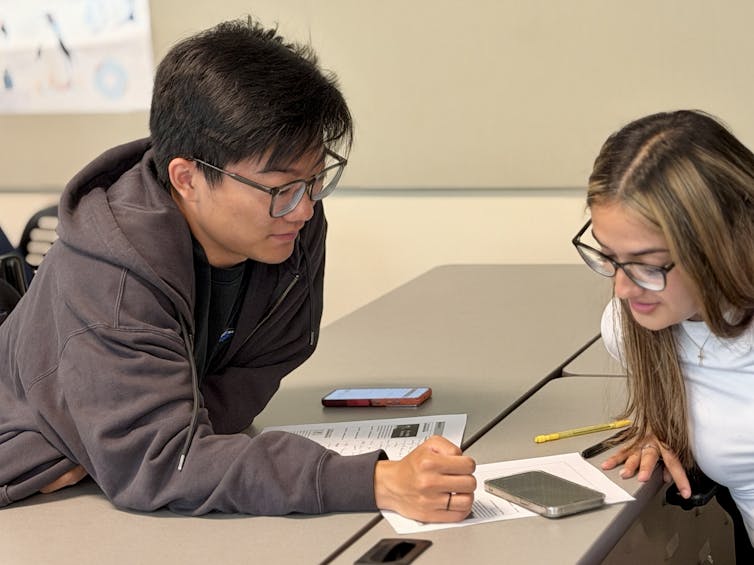 A Spanish learner from China negotiates meaning with an English learner from Mexico in California. Gabriel Guillén, 2025, CC BY-SA A Spanish learner from China negotiates meaning with an English learner from Mexico in California. Gabriel Guillén, 2025, CC BY-SAWhere AI falls shortThe latest AI technologies, such as those used by Apple’s newest AirPods to instantly interpret and translate, certainly are powerful tools that will help a lot of people interact with anyone who speaks a different language in ways previously only possible for someone who spent a year or two studying it. It’s like having your own personal interpreter. Yet relying on interpretation carries hidden costs: distortion of meaning, loss of interactive nuance and diminished interpersonal trust. An ethnography of American learners with strong motivation and near limitless support found that falling back on speaking English and using technology to aid translation may be easier in the short term, but this undercuts long-term language and integration goals. Language learners constantly face this choice between short-term ease and long-term impact. Some AI tools help accomplish immediate tasks, and generative AI apps can support acquisition but can take away the negotiations of meaning from which durable skills emerge. AI interpretation may suffice for one-on-one conversations, but learners usually aspire to join ongoing conversations already being had among speakers of another language. Long-term language learning, while necessarily friction-filled, is nevertheless beneficial on many fronts. Interpersonally, using another’s language fosters both cultural and cognitive empathy. In addition, the cognitive benefits of multilingualism are equally well documented: resistance to dementia, divergent thinking, flexibility in shifting attention, acceptance of multiple perspectives and explanations, and reduced bias in reasoning. The very attributes companies seek in the AI age – resilience, lifelong learning, analytical and creative thinking, active listening – are all cultivated through language learning. Rethinking language education in the age of AISo why, in the increasingly multilingual U.K. and U.S., are fewer students choosing to learn another language in high school and at university? The reasons are complex. Too often, institutions have struggled to demonstrate the relevance of language studies. Yet innovative approaches abound, from integrating language in the contexts of other subjects and linking it to service and volunteering to connecting students with others through virtual exchanges or community partners via project-based language learning, all while developing intercultural skills. So, again, what’s the value of learning another language when AI can handle tourism phrases, casual conversation and city navigation? The answer, in our view, lies not in fleeting encounters but in cultivating enduring capacities: curiosity, empathy, deeper understanding of others, the reshaping of identity and the promise of lasting cognitive growth. For educators, the call is clear. Generative AI can take on rote and transactional tasks while excelling at error correction, adapting input and vocabulary support. That frees classroom time for multiparty, culturally rich and nuanced conversation. Teaching approaches grounded in interculturality, embodied communication, play and relationship building will thrive. Learning this way enables learners to critically evaluate what AI earbuds or chatbots create, to join authentic conversations and to experience the full benefits of long-term language learning. Gabriel Guillén, Professor of Language Studies, Middlebury College and Thor Sawin, Professor of Linguistics, Middlebury College This article is republished from The Conversation under a Creative Commons license. Read the original article. |

Britney Spears returns to Instagram, talks about 'boundaries' (2025-12-24T12:45:00+05:30)
 (Photo: Britney Spears/Instagram) IANS Los Angeles, (IANS) Popstar Britney Spears has made a comeback on social media weeks after appearing to deactivate her account amid a spat with her ex-spouse Kevin Federline. After a string of erratic posts and a public clash with her former husband, Kevin Federline, the 43-year-old singer appeared to deactivate her account earlier on November 2, with her page showing a message that it “may have been removed”. Returning to Instagram, the Toxic hitmaker reflected on her "crazy" year and encouraged her followers to build "boundaries,” reports femalefirst.co.uk. Alongside a screenshot of one of her videos in a racy ensemble, she wrote: “So much has happened this year, it’s crazy … I try to live within my means and the book, ‘Draw the Circle’ is an incredible perspective. “Get your ballerina, circle, and own your boundaries. It’s incredibly strict and somewhat of a form of prayer but with so many endless possibilities in life, it’s important to do you and keep it simple. I know there is a confusing side too. The devil is in the details but we can get to that later (sic)" Fans have shown concern since the singer shared clips of herself dancing with visible bruises on her arms and cryptic captions about her sons, Sean Preston, 20, and Jayden James, 19. In one post, Spears appeared in a plunging pink swimsuit and knee-high black boots, posing in front of a mirror in her Los Angeles home. The background showed piles of clothes on the floor, prompting renewed discussion about her wellbeing. In another clip last month, she revealed a “horrible” leg injury, explaining she had “fell down the stairs” and her leg “snaps out now and then”. She said: “Not sure if it’s broken but for now it’s snapped in!!! Thank u god.”Britney captioned the same video with a message referencing her faith and her children, saying: “My boys had to leave and go back to Maui… this is the way I express myself and pray through art… father who art in heaven… I’m not here for concern or pity, I just want to be a good woman and be better… and I do have wonderful support, so have a brilliant day !!!” Britney Spears returns to Instagram, talks about 'boundaries' | MorungExpress | morungexpress.com |
Esha Deol says 'still grieving' as she expresses her desire to take a break from social media (2025-12-20T12:29:00+05:30)
 Photo: Esha Deol/ Instagram) IANS Mumbai, December 19 (IANS) Actress Esha Deol, who is still grieving the loss of her beloved father and legendary actor Dharmendra, has expressed her wish to take a break from social media for some time. The 'Dhoom' actress revealed that due to the unfortunate circumstances, she had been keeping her work commitments on hold for some time; however, she intends to post all of them in the near future. Taking to the Stories section of her Instagram handle, Esha wrote, "I had kept a few work commitments on hold for a long time which I would be posting & sharing with you all now in the coming days. (sic)." Reiterating that this is indeed a very difficult time for her as a daughter and she is still grieving the loss of her 'precious' father, Esha added, "Please understand me as a human & most importantly as a daughter who is still grieving the loss of her most loving precious father. A loss I would never get over." The 'Yuva' actress said that if she could have her way, she would love to go on a social media break, but the nature of her work does not allow her to do so. Esha expressed, "If I had things my way I would wish to not be on this platform for sometime and just take a break. But I can't do that. So try & be kind and understanding. Thank you for the love & support always... love you all." Earlier, remembering dad Dharmendra on his 90th birthday on December 8, Esha promised to continue his legacy with 'pride & respect'. Her emotional post read, "I so painfully miss you papa … your warm protective hugs that felt like the cosiest blanket , holding your soft yet strong hands which had unspoken messages & your voice calling out my name that followed with endless conversations , laughter & shayaris . Your motto “ always be humble , be happy, healthy & strong.""I promise to continue your legacy with pride & respect .And I will try my best to spread your love to the millions who love you as I do. I love you papa", she concluded the note, signing off as “Your darling daughter, Your Esha, your Bittu.” Esha Deol says 'still grieving' as she expresses her desire to take a break from social media | MorungExpress | morungexpress.com |
Screenagers face troubling addictions from an early age (2025-12-12T11:27:00+05:30)
 Early exposure can lead to addiction. Brit., CC BY-NC-ND
Joseph Attard, King's College London and Mark Griffiths, Nottingham Trent University Early exposure can lead to addiction. Brit., CC BY-NC-ND
Joseph Attard, King's College London and Mark Griffiths, Nottingham Trent UniversityIn 1997, Douglas Rushkoff boldly predicted the emergence a new caste of tech-literate adolescents. He argued that the children of his day would soon blossom into “screenagers”, endowed with effortless advantages over their parents, having been raised from birth on a diet of computers and micro-chipped devices. Fast-forward to 2014: the screenagers have come of age in a world ruled by Twitter and Candy Crush Saga. A substantial body of evidence addresses the ways in which media saturation shapes the identities of children and adolescents. While there are clear benefits to maturing as a digital native, a number of experts are concerned about the physical and psychological health of our screenagers. The perils of media-immersionThere are advantages of tech-literacy from an early age such as gaining IT skills that will serve you well in the future but there are risks too. Aside from the dangers of social isolation and physical inactivity, there are also dangers that come not directly from any IT medium itself, but what happens when children are exposed to them. The ability to access pornography or gamble online throws up all kinds of issues when children are involved. Particularly insidious are “foot-in-the-door” products which, combined with big data marketing techniques, specifically target adolescents and stimulate pathological behaviour. For example, a number of free Facebook games, including Zynga Poker and Slotomania, normalise gambling and divorce the thrill of playing from the consequences of losing. The player gets to experience the highs of winning but because there is no money involved, they don’t suffer any real life consequences when they lose. This poses a major risk and could lead to problem gambling in adolescence. Other freemium app and internet games also carry a risk factor for pathological behaviour. So-called “casual games” such as Flappy Bird, Bejeweled and Candy Crush Saga use behavioural conditioning techniques to keep players invested for long stretches, which may inhibit the social development of youngsters. And even if we don’t buy into the moral panic so often spread by the media, there is evidence to suggest that sustained access to pornography can have detrimental effects on young people. Mental health website Psych Central reports that not only is pornography easy to stumble across online (with search terms like “toy” often throwing up adult images) repeated exposure can be over-stimulating and potentially addictive for young people. According to the site, “Cybersex addiction functions in a similar way to any other addiction, leading to a cycle of preoccupation, compulsion, acting out, isolation, self-absorption, shame and depression as well as distorted views of real relationships and intimacy.” Most susceptible to compulsive porn viewing are teens with limited parental support, which also correlates with unsupervised web access. New addictionsWhile the addictiveness of certain activities is reasonably well established, the more general concept of “media addiction” in young people is harder to pin down. For a start, it isn’t easy to define addiction as it applies to any activity, even traditional problems such as gambling. So when it comes to new technologies and services, the picture becomes more confused. It is tempting to discuss “media addiction” as a catch-all term for spending too much time online but there are so many opportunities for digital natives to engage in harmful activities that we ought to think in more detail about the problems that can arise for them. While we might group people together as “Facebook addicts”, for example, there may well be a big difference between someone who spends an unhealthy amount of time growing virtual tomatoes on Farmville and another who might be pathologically engrossed in instant messaging. Starting youngThese phenomena are disconcerting enough on their own but we also need to address the fact that for today’s youngsters, the process of media immersion often begins in very early childhood. Last year, campaign group Common Sense Media and electronics company VTech carried out a survey of 1,463 parents with children aged under eight in the US and found 75% had access to smart devices. This was up from 52% in 2011. This suggests that by the time they hit their teens, there is a high probability that young children will be active participants in global information networks. Whereas children of the 1990s were raised on a diet of discontinuous digital media (MTV and 16-bit gaming), the next wave of screenagers will hold multiple social media accounts, exposing them to all the hazards this level of connectivity implies. From underage users viewing gambling as a source of wealth to adolescents whose formative sexuality is filtered through internet porn, the influence of media-immersion on developing minds is disquieting. One can only imagine the mental state of young people when a universe of information, temptations and perils can be carried around in their pocket. While it’s obvious that internet-use carries huge advantages for young people, they also need to be educated about the dangers before addictions develop. Joseph Attard, Film Studies PhD Researcher, King's College London and Mark Griffiths, Director of the International Gaming Research Unit and Professor of Gambling Studies, Nottingham Trent University This article is republished from The Conversation under a Creative Commons license. Read the original article. |
