
 Minister Pennelope Beckles-Robinson (third from left) takes a photo with the LinkTT Partners (from left to right) - Niall Legerton, John Victor, Kenwyn Peters, Rae Ann George, Meranda Ramoutar, Genevieve Julien and Roberta Norman-Reverand. - Photo courtesy George Pont Minister Pennelope Beckles-Robinson (third from left) takes a photo with the LinkTT Partners (from left to right) - Niall Legerton, John Victor, Kenwyn Peters, Rae Ann George, Meranda Ramoutar, Genevieve Julien and Roberta Norman-Reverand. - Photo courtesy George PontGEORGE Pont Business and Financial Services seeks to "bridge the digital divide" in Trinidad and Tobago by partnering with Neal and Massy Credit Union to provide loans to citizens to be used to purchase a range of electronics. The initiative – launched on May 7 – is also a partnership with Unicomer, Flow and UWI-ROYTEC. On its website (linktt.net), there are several cellphones, tablets, laptops, TVs, gaming consoles and internet packages. It adds that new devices will continually be added. Brands included are Apple, Samsung, Acer, HP, Lenovo, Sony, and TCL. Users can order devices online, then must take their confirmation to Neal and Massy Credit Union to apply for a loan. In a press release by LinkTT, it said Planning and Development Minister Pennelope Beckles praised the initiative, saying it is about "empowering our citizens and integrating every individual into the digital future of Trinidad and Tobago. "This initiative epitomises the resilience, creativity, and entrepreneurial spirit that define our nation. It represents our collective ambition to drive comprehensive digital transformation and inclusivity, commitments deeply rooted in our national ethos." She said technology is the "great equaliser," and reaffirmed the government's "unwavering commitment to initiatives like LinkTT, which propel us toward realising our Vision 2030 goals. "This project highlights our thrust to equip every citizen with the tools required to thrive in the digital age, paving the way for a more connected and equitable future." CEO George Pont said bridging the digital divide must be addressed via collaboration on infrastructure, access, skills, and usage. "Digital inclusion, digital literacy, the digital divide is everyone’s concern. It must be everyone’s concern. "We are moved to take action, to ask the right questions, and to engage multidisciplinary experts – locally and globally." He said LinkTT is an "ecosystem" meant to "intervene, interrupt, and awaken us to the fact that the future is today and we now live in a new world that requires a fundamental shift in how we inhale and exhale – in other words, how we navigate this thing we call life. "There was a time when technology was seen as a 'gadget thing' or a 'geek thing' that just a small sector of the population was interested in. "Fast-forward to today and technology has not only reshaped our educational, professional, scientific, recreational, intellectual, and spiritual disciplines but it has fundamentally impacted the way we communicate, interact, record memories, and share experiences." In addition, Neal and Massy Credit Union CEO said he was proud to be leading the financial sector's involvement "in this transformative project. "We are thrilled to pioneer this digital inclusivity initiative, demonstrating our commitment to community and innovation."LinkTT's website says eventually, the initiative will be available to all credit unions "in phases." LinkTT to 'bridge digital divide' – Loans to buy electronics, internet - Trinidad and Tobago Newsday |
California Launches Free Behavioral Health Apps for Children, Young Adults, and Families (2025-10-17T10:45:00+05:30)
 Photo by Annie Spratt Photo by Annie SprattCalifornia’s Department of Health Care Services launched two free behavioral health digital services for all families with kids, teens, and young adults up to age 25. The partnerships have been years in the making, as the state announced in 2021 the opportunity to collaborate on a new initiative to combat the youth mental health crisis. They selected two platforms, Brightline for young kids and Kooth‘s Soluna for young adults and teens to be the cornerstone of Governor Gavin Newsom’s Children and Youth Behavioral Health Initiative (CYBHI). The tools are free for all California families, regardless of income or health insurance. “About two-thirds of California kids with depression do not receive treatment. This platform will help meet the need by expanding access to critical behavioral health supports,” said Dr. Mark Ghaly, Secretary of the California Health & Human Services Agency. “Our young people will have an accessible option to get the help they need.” Between 2019 and 2021, about one-third of California adolescents experienced serious psychological distress, with a 20 percent increase in adolescent suicides. Meanwhile, the mental health provider shortage is causing longer wait times for appointments to community-based mental health providers. Availability is particularly limited among the uninsured and people with low incomes. “The Behavioral Health Virtual Services Platform will give access to services early on, reducing the likelihood of escalation to more serious conditions,” said Ghaly. 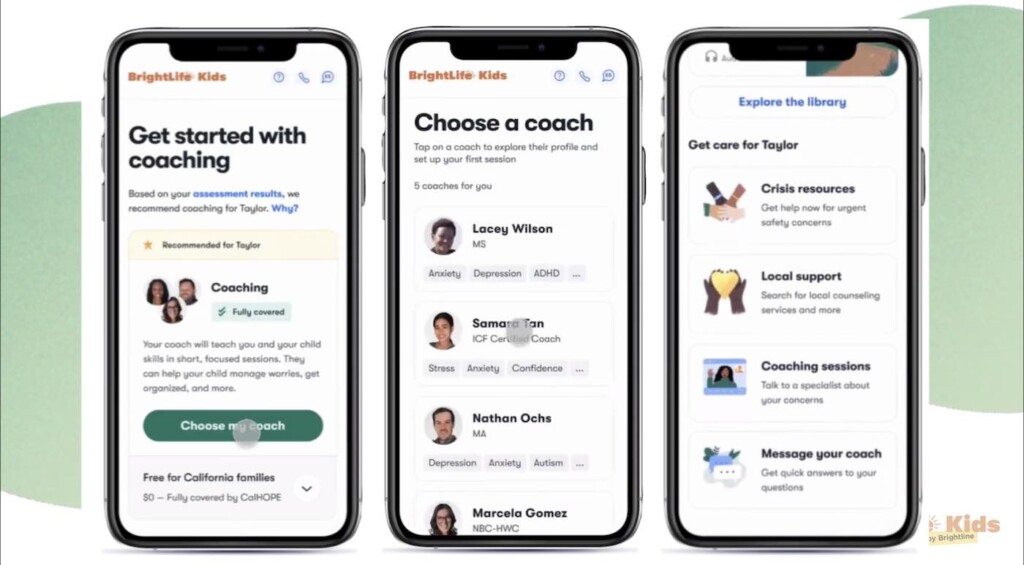 BrightLife Kids BrightLife KidsBoth web and app-based applications will offer coaching services in English and Spanish, as well as telephone-based coaching in all Medi-Cal threshold languages. The platforms include:
Both apps have strict privacy and confidentiality requirements and must adhere to all applicable state laws and regulations pertaining to privacy and security. Each app will also follow robust safety and risk escalation protocols. Trained behavioral health professionals will monitor app usage to identify potential risks, and licensed behavioral health professionals will be on standby to intervene, if clinically appropriate. Where to find the apps. BrightLife Kids is available for download on IOS devices in the Apple App Store. The app for Android devices will be available in the summer, but it’s also accessible from all devices—or by computer—at CalHOPE.org. The Soluna app for older youth is available for both IOS and Android devices in the Apple App Store and Google Play Store. California Launches Free Behavioral Health Apps for Children, Young Adults, and Families See a preview of what to expect in the videos below, starting with the younger kids… Check out the app for older kids… |

E-services in India’s states, UTs cross 21,060 (2025-09-08T10:51:00+05:30)
 New Delhi, Aug 26 (IANS): The total number of e-services provided across states and UTs in the country have touched the of 21,062 mark, with the majority of these services (7,065) falling under the Local Governance and Utility Services sector, according to a report released by the Department of Administrative Reforms and Public Grievances (DARPG) on Thursday. Another 424 new e-services have been added in April by various states and UTs, with Tripura contributing the highest number of additions across all focus sectors, the National e-Governance Service Delivery Assessment (NeSDA) report states. A total of 1,599 out of 2,016 mandatory e-services (56 for each of the 36 states/UTs) are now available online across all 36 states and union territories, achieving a saturation rate of over 79 per cent. There were 16 states and UTs that achieved over 90 per cent saturation, while Maharashtra and Uttarakhand achieved 100 per cent saturation. The report highlights Chandigarh’s commitment to strengthening public service delivery through the Right to Services (RTS) framework. It also brings attention to ongoing efforts to unify service delivery and ensure real-time transparency for citizens. The report also captures the details of e-services by states and UTs made available through their single unified service delivery portals and status of incorporation of the three new additional assessment parameters that have been included in the NeSDA framework, namely, Open Government Data, e-participation and leveraging Emerging Technologies. Comprehensive service delivery portals of Central government ministries/departments, the Goods and Services Tax Portal and National Cyber Crime Reporting Portal have been highlighted as examples of best practices in the report. The Department of Administrative Reforms and Public Grievances (DARPG) formulated the National e-Governance Service Delivery Assessment (NeSDA) Framework in 2019 to assess states and UTs and Central Ministries with regard to the delivery of their e-services as a benchmarking exercise, covering seven sectors. DARPG conducts the NeSDA study biennially. DARPG monitors the progress made in e-service delivery across states/UTs through inputs provided by them on NeSDA Way Forward Dashboard, NeSDA Way Forward monthly reports and regular review meetings with SPoCs from states and UTs. So far, 25 NeSDA Way Forward Monthly Reports and the Annual Report 2023 have been published to monitor the status of e-service delivery across states and UTs.This series of NeSDA Monthly Reports systematically monitors and evaluates the scale and quality of e-Services provided across all states and Union Territories since its inception in April 2023. The update has consistently reported on three key categories of online services each month: all e-Services, mandatory e-Services, and those delivered through a unified portal. E-services in India’s states, UTs cross 21,060 | MorungExpress | morungexpress.com |
Why is Amazon building a ‘top secret’ $2 billion cloud for Australia’s military intelligence? (2025-02-20T13:20:00+05:30)
|
Amazon has secured a A$2 billion contract with the Australian Signals Directorate – the agency responsible for foreign signals intelligence and information security. A local subsidiary of Amazon Web Services will build a Top Secret Cloud to provide secure data storage for military intelligence. The deal will securely manage top secret data vital to Australia’s national security. This contract is expected to last over a decade. It will build three secure data centres at undisclosed locations in Australia. Prime Minister Anthony Albanese stated this project will “bolster our defence and national intelligence community to ensure they can deliver world-leading protection for our nation.” Set to be operational by 2027, the project is expected to create over 2,000 jobs and cost billions more in operating expenses over the coming years. So – why Amazon? And does Australia really need it? Why Australia needs a secret cloudAustralia faces a rising tide of security challenges. The capability to securely store military intelligence is vital to guard against a host of potential threats. The Australian Signals Directorate’s Director-General, Rachel Noble, explained the project will provide a “state-of-the-art collaborative space for our intelligence and defence community to store and access top secret data.” The cloud is also part of the directorate’s REDSPICE program, which aims to improve Australia’s intelligence capabilities and cyber defences. By moving to a modern cloud system, Australia can better protect its sensitive data. It will also improve coordination between different security agencies. Why Amazon Web Services?You may only know of Amazon as an online retail giant. Amazon Web Services (AWS) is a tech subsidiary of Amazon. It was actually a pioneer in the cloud services business. Today, it provides cloud computing services to tens of thousands of businesses and governments worldwide. AWS’s market share among the top ten cloud providers grew to 50.1% in 2024. Microsoft Azure and Google Cloud are the next two largest providers. Known for its reliability, scalability and security, AWS already provides similar services to other governments and organisations globally. This includes the United States Department of Defense and the Central Intelligence Agency (CIA), as well as all three of the United Kindgom’s intelligence agencies. Will the new cloud be safe?When we think of “the cloud,” we often picture the internet we use every day. However, the Top Secret Cloud that AWS will build for Australia’s military is very different. It’s a private, highly secure system entirely insulated from the public internet. While AWS is the contractor, the data centres will be built to the Australian Signal Directorate’s specifications. The cloud will use advanced encryption to protect data. No system is completely hack-proof, but this setup makes it extremely difficult for unauthorised individuals to access the information. The Australian government has emphasised it will maintain full control over the data stored in the cloud. Only staff with high-level security clearance will work on the project. Broader trendThis move to a secure cloud is part of a broader trend in government and military technology worldwide. Many countries are updating their old computer systems to take advantage of new technology. This can offer greater flexibility, better performance, and potentially lower costs in the long run. The project also has international implications. The Top Secret Cloud will ease collaboration with partner nations. Similar data clouds have already been established in the US and UK, allowing for the sharing of large amounts of information between allies. It’s worth noting that potential adversaries are also investing heavily in similar technology. By developing this Top Secret Cloud, Australia aims to stay ahead of the game in the rapidly evolving cyber threat environment. In the coming years, we’ll likely see more countries adopt similar cloud systems for their defence and intelligence needs. David Tuffley, Senior Lecturer in Applied Ethics & CyberSecurity, Griffith University This article is republished from The Conversation under a Creative Commons license. Read the |

Smartwatch may help boost treatment for depression (2024-08-22T14:24:00+05:30)
 |
3 in 4 feature phone users in India consider switching to smartphones: Study (2024-07-24T11:44:00+05:30)
 New Delhi, April 5 (IANS) While feature phones remain a lifeline for many people in India, about three in four users have expressed interest in switching to smartphones, a new study revealed on Friday. According to CyberMedia Research (CMR), India is experiencing a surge in digital acceleration, driving a renewed interest in affordable 4G smartphones and even 5G offerings within the sub-Rs 10,000 segment. "Consumers are increasingly seeking feature phones with a more premium experience, including features like UPI payments. However, the inherent limitations of these devices are ultimately driving them towards smartphones, particularly affordable 4G and 5G models," said Prabhu Ram, Head - Industry Intelligence Group (IIG), CMR. The study surveyed over 2,000 mobile phone users across major Indian cities. Moreover, the study revealed that consumers are increasingly preferring feature phones that provide longer battery life (78 per cent), ease of use (74 per cent), affordability (57 per cent) and offer digital capabilities. Indians spend an average of three hours daily on calls (87 per cent), alarms (72 per cent), and texting (62 per cent). One-third utilise apps like weather (47 per cent), news (34 per cent), and social media (24 per cent), the study found.While acknowledging benefits, users cited disadvantages of feature phones like poor camera quality (62 per cent), lack of advanced apps (56 per cent), and limited internet access (53 per cent), fueling the shift to smartphones, including 5G models. 3 in 4 feature phone users in India consider switching to smartphones: Study | MorungExpress | morungexpress.com
|
90% Indian CIOs to increase spending on AI tools in 2024: Report (2024-07-19T11:15:00+05:30)
 The report by Canva, the world’s only all-in-one visual communication platform, is based on a survey of more than 1,360 CIOs across India, USA, UK, France, Germany, Spain, Brazil, Mexico, and Australia. The report showed that nearly all CIOs (93 per cent) plan to increase their budget to make investments in AI apps, with over half (51 per cent) planning budget rises of more than 50 per cent. IT leaders recognise the benefits of adopting AI, such as saving time on creative or strategic tasks (53 per cent), helping consolidate apps (53 per cent), and offering greater insights to guide business decisions (49 per cent). Identifying the right solution is a challenge, with 89 per cent saying that there are already too many AI tools available, causing confusion and overlap for employees. “Our findings reinforce that CIOs in India want to be agents of change and innovation, by choosing technology that helps their organisations have a greater impact while consolidating cost and reducing complexity,” said Cameron Adams, co-founder and chief product officer, Canva. The report showed that more and more apps are entering the workplace, but consolidation and reducing complexity are priority. With the rise in the number of new applications, application sprawl (the growth in individual applications used in a workplace) is a challenge for 88 per cent of CIOs, with 47 per cent being very concerned with increasing complexity, but they plan to reduce it. Fifty-two per cent are planning on some level of consolidation, with 30 per cent planning for significant levels. The increase in apps is also overwhelming IT teams, the report said. Over half (55 per cent) CIOs report, that they don’t have enough staff to train employees on new apps including on their proper use. Further, integrating AI is also high on the agenda of the CIOs. Nearly all CIOs (92 per cent) strongly agree that AI tools can dramatically improve both their role and their employees' experience, but cite integrating AI (56 per cent), access to IT talent (34 per cent), and data security (22 per cent) as the most common challenges. Most seem ready to leverage the technology, with 79 per cent saying they have firm guardrails in place to ensure safe and responsible use.“Navigating the avalanche of new technologies designed to make business easier is proving to be harder than ever. The balancing act CIOs face is unenviable: Innovate with AI but don’t contribute to app sprawl,” Adams said. 90% Indian CIOs to increase spending on AI tools in 2024: Report | MorungExpress | morungexpress.com
|
New Concept Lets Elon Musk’s Cybertruck Drive on Water (2024-03-26T11:04:00+05:30)
 SWNS SWNSA James Bond-inspired concept will allow Elon Musk’s Cybertruck to be driven on water. The Cybercat idea is designed to quickly transform Tesla’s vehicle into an all-electric high performance amphibious catamaran. It sees the addition of electric outboard motors, pontoons, and optional hydrofoils in the Foiler model, which fold or collapse into parts to be stored in the vehicle. They can then be installed “by a single person in less time than it takes to launch a boat.” Elon Musk has previously said the Cybertruck design “influenced partly by The Spy Who Loved Me”, and even bought the 1976 Lotus Espirit featured in the film. Now Cybercat creator Anthony Diamond believes that taking the vehicle onto the water will “pay homage to this passion.” He explains, “We believe that with more than 1.3 million Cybertruck reservations, the market potential for Cybercat is immense and total gross margins comparable to those generated from the Tesla Model S and X vehicle lines combined are achievable.” The Cybercat has estimated pricing of between 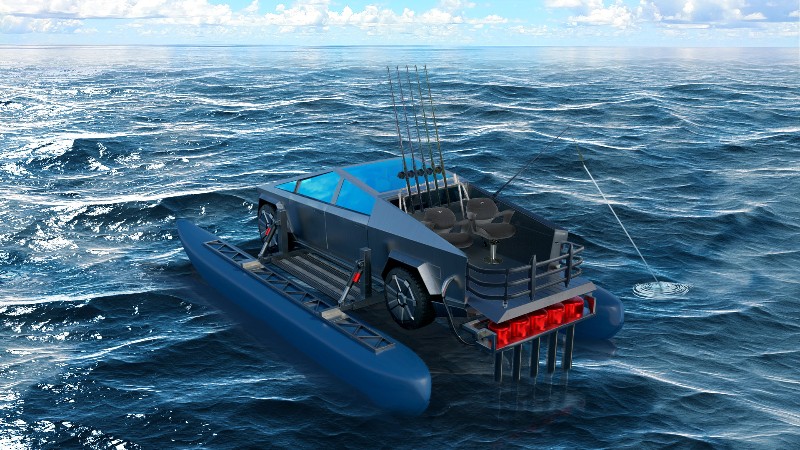 SWNS SWNS$22,900 and $32,900, while the Foiler would market at $35,400 to $42,900. Cybercat would have a top speed of around 25+ mph and a range of 115 miles, while the Foiler is expected to reach 40+ mph with a similar range. Diamond says the patent pending concept is “not a third-party aftermarket solution. Instead, we intend to work directly with OEMs (original equipment manufacturer) to bring the concept to market.” “We are both serious and excited about this concept and intend to work with OEMs to bring these watercraft to market,” he adds. Seattle-based Cybercat company TSWLM Electric Vehicles Inc.—named after the Bond film —are now accepting emails to demonstrate market interest and “substantially increase the probability that Cybercat becomes real.  SWNS SWNSCYBERCAT SPECS (estimated):
CYBERCAT FOILER SPECS (estimated):
|
Engineers Build Efficient Chip So Fast it Can Transmit All Internet’s Traffic in Under a Second (2024-03-18T14:27:00+05:30)
 By splitting a single laser beam into different wavelengths of light, engineers have been able to transmit data at a rate of almost twice the combined internet traffic of the world per second. This head-scratching achievement was made with just a laser and single optical chip. Engineers from Chalmers University of Technology and the Technical Univ. of Denmark fired an infrared laser through a splitter called a “frequency comb” which divided the light into many different colors. Each of the colors, or frequencies, can carry data by modulating their amplitude, phase, and polarization. The total amount of data that can be encoded is 1.8 petabits per second, or 1.8 million gigabytes; 800,000 more than the average global bandwidth of the whole internet. A single optical chip designed by Chalmers was easily able to carry 1.8 Pbit/s, which—with contemporary state-of-the-art commercial equipment—would otherwise require more than 1,000 lasers. The work of Leif Katsuo Oxenløwe et al. showed also that the technology is scalable. “Our calculations show that—with the single chip and a single laser—we will be able to transmit up to 100 Pbit/s.” “The reason for this is that our solution is scalable—both in terms of creating many frequencies and in terms of splitting the frequency comb into many spatial copies and then optically amplifying them, and using them as parallel sources with which we can transmit data,” said Professor Oxenløwe, who added it bodes well for emissions targets, of all things. “In other words, our solution provides a potential for replacing hundreds of thousands of the lasers located at Internet hubs and data centers, all of which guzzle power and generate heat. We have an opportunity to contribute to achieving an Internet that leaves a smaller climate footprint.” In May this year, New Atlas reports that a 1.04 Pbits/s transmission record was made in Japan with different technologies. Oxenløwe noted that there are people all over the world working to make these kinds of internet capacities a reality.USE Up Some Bandwidth And Beam This Story Over ToEngineers Build Efficient Chip So Fast it Can Transmit All Internet’s Traffic in Under a Second |
11-year-old Indian climate activist inspires action through social media (2023-10-18T11:09:00+05:30)
 Licypriya Kangujam, 11, is an environmental activist from New Delhi, India. She holds a climate justice sign in front of the White House, which she visited. MUST CREDIT: Courtesy of Licypriya Kangujam Licypriya Kangujam, 11, is an environmental activist from New Delhi, India. She holds a climate justice sign in front of the White House, which she visited. MUST CREDIT: Courtesy of Licypriya KangujamAt age 11, Licypriya Kangujam has already traveled the world, but her adventures haven’t been all fun. She’s been trying to help save the planet by getting the attention of people in power. “Asking [for] clean air to breathe, clean water to drink and clean planet to live are our basic rights,” said Licypriya (pronounced lih-see-PREE-yaa), who is also called Licy. Inspired by teenage Swedish environmental activist Greta Thunberg, Licy began protesting at age 6. “I started spending a week outside the Indian Parliament House to draw the attention of Prime Minister Narendra Modi to pass a climate change law in India,” she told KidsPost in an email. She also founded the Child Movement, an organization that calls on world leaders “to take urgent climate action to save our planet and our future.” Last month, Licy traveled from her home in New Delhi, India, to New York City, to attend the United Nations (U.N.) General Assembly. That’s when 193 countries send representatives to talk about the most important issues for the world. Licy participated in several events at the U.N., on climate and education, for example. She met other activists, including Malala Yousafzai, who received the 2014 Nobel Peace Prize for her work in helping girls to get an education. Kangujam Licy also traveled to Washington, D.C., and visited the White House. But Licy might be best-known for getting officials at the Taj Mahal mausoleum to clean up trash at the historic site. When she visited it for the first time in June, she says she was shocked to see piles of garbage around the nearly 400-year-old white marble building, where emperor Shah Jahan and his wife are buried. She held her own protest, holding up a sign that read “Behind the Beauty of Taj Mahal is Plastic Pollution” and posing for a photo. Licy said social media has been a powerful tool for her, allowing her to stay up-to-date on environmental issues, as well as speak out about them. It also helps her gain support from her followers. She has almost 21,000 followers on Instagram, more than 37,000 subscribers on YouTube and almost 157,000 followers on Twitter. Her mother manages her accounts, which require owners to be at least 13 years old. “Whenever I raise my voice, people keep increasing[ly] following me,” she said. “At the same time, I faced lots of false propaganda, threat[s] and abuse to silence my voice.” Despite all that, Licy says her nonactivist life is normal. She’s a fifth-grader at Ryan International School, where her favorite subject is math. When she isn’t studying or accepting invitations to speak at other schools, she swims, paints and watches the cartoon “Doraemon” with her 8-year-old sister, Irina. She also has an initiative encouraging kids to plant trees every Monday, hoping to get to 1 million trees planted this year, “to make our planet green again,” she said. Licy has suggestions for other kids who want to be activists: Persuade your parents to walk, bike or take public transportation. Stop using single-use plastics. And make sure trash makes it to the wastebasket. “Many people told me that I’m too young to get involved in such activism, but … I strongly believe that children can lead the change,” she said. “We need to keep speaking up about the climate crisis and … to hold lawmakers accountable for their political decisions.”Source: https://www.newsindiatimes.com// |
Elon Musk hopes to have Twitter CEO toward the end of year (2023-02-20T15:33:00+05:30)
 |
Twitter to introduce edit button for users (2022-09-06T15:34:00+05:30)
 Popular social media giant, Twitter has announced it will roll out an editing feature to subscribers of its premium Twitter Blue service later this month. According to a report by the news agency AP, Twitter said that this is one of the most anticipated services of Twitter. Through the edit feature, users will be able to edit their 280-character message within 30 minutes after sending a tweet. If a tweet has been edited, a separate icon and timestamp will appear. Users can see what the message looked like before the modification. That’s means if the message is edited, the original message will remain. Twitter also said that a small group of users are currently testing this feature, so that any issues can be identified and resolved quickly. How this feature can be misused is also being tested. Twitter indicated that edit feature will be rolled to all users over time. Source: https://www.daily-bangladesh.com/ |
WhatsApp may roll out 'Sign Out' feature in the app (2021-02-18T19:54:00+05:30)
 FEB 18, 2021 WASHINGTON: American messaging application WhatsApp is reportedly working on a new 'log out' feature that will allow users to sign out of the app whenever they want to take a break from the app. According to Mashable, WhatsApp is continually working on new features and updates, and 'log out' is reportedly one of the new features it is coming out with. A popular website WABetaInfo that posts regular news around new WhatsApp features first spotted the change. According to the website, WhatsApp will have a 'log out' feature that has been on demand by users for quite some time now. Especially given the fact that users only have the choice to either uninstall the app or delete it if they want to take a short break from the app. The 'log out' feature is basic functionality that exists on a slew of other apps. Mashable reported that another WhatsApp feature called the 'Multi-Device support' has been spotted on WhatsApp beta for iOS users. This feature was also spotted by WABetaInfo, which revealed that "WhatsApp is developing two different kinds of multi-device - Multi-device with WhatsApp Web where you can use WhatsApp Web without your main phone to be connected to the Internet. And multi-device with other devices where you can connect up to 4 different devices to your main WhatsApp account." Copyright © Jammu Links News Source: Jammu Links News |
Facebook unveils AI translator for 100 languages (2020-12-29T20:45:00+05:30)
 Facebook on Monday unveiled software based on machine learning which the company claimed was the first to be able to translate from any of 100 languages without relying on English. The open-source artificial intelligence software was created to help the massive social network deliver content better in 160 languages to its more than two billion users around the world. “This milestone is a culmination of years of Facebook AI’s foundational work in machine translation,” research assistant Angela Fan said in a blog post. Fan said the new model is more accurate than other systems because it does not rely on English as an intermediary translation step. “When translating, say, Chinese to French, most English-centric multilingual models train on Chinese to English and English to French, because English training data is the most widely available,” Fan wrote.Facebook said it already handles an average of 20 billion translations every day on its news feed, and that it hopes the new system will deliver better results. Source: https://www.daily-bangladesh.com/ |
Whatsapp rolls out new shopping button (2020-12-10T11:36:00+05:30)
 NOV 10, 2020 WASHINGTON: In a bid to make the shopping experience easier for customers, WhatsApp Business is introducing the new shopping button. According to Mashable, the shopping button does not bring in any new functionality to the table but it simply makes the process of discovering product catalogues easier. The button, which looks like a storefront icon, will replace the call button within conversations. However, the users will still be able to place voice or video calls in the application. With this new tweak, WhatsApp believes that the customers will be able to discover products easily. While this might seem like a simple change, the new addition is a sign of future development. Recently, Facebook announced that it will soon bring in-app shopping to WhatsApp. As reported by Mashable, the launch of in-app shopping will make it tremendously easier for customers to purchase goods right from the application. Although, it is not clear as to when this will happen, teasers shared by WhatsApp indicate that users might not have to wait too long for the upcoming feature. Copyright © Jammu Links News Source: Jammu Links News |
The power of social media: It can win or lose a war today (2020-12-01T13:17:00+05:30)
 In the summer of 2014, a motley but a brutally violent group of approximately 1500 hardened terrorists/fighters fully armed (even swords) accomplished the impossible in military parlance. They drove away four army divisions and armed police (fully trained and equipped by the US) from Mosul and most parts of Northern Iraq (and later Eastern Syria) and established the caliphate of IS ((ISIL/ISIS or Daesh in Arabic). This act is a classic case of the power of social media winning a war. In fact, a propaganda handbook of the IS states that "Media weapons (can) actually be more potent than atomic bomb". How did this happen? They were not quiet about it but announced it to the world months in advance. This was no secret mission but well-orchestrated choreographed information and psychological campaign with social media being the pivotal tool. Internet and social media novices, boosted by diehard fans and amplified by an army of Twitter bots, WhatsApp and Facebook posts covered their march. They even created a smartphone app, so that jihadi fans following along at home could link their social media accounts in solidarity, boosting the invaders’ messages even further. By using appropriate hashtag #AllEyesOnISIS they ensured that the message went viral and became the top-trending hashtag on Arabic Twitter. They delighted in showcasing their brutality, gruesome torture, and execution of those who dared resist. Their ‘shock and awe’ strategy achieved global coverage: ISIS took on the power of a non-kinetic artillery barrage, its thousands of messages spiraling out in front of the advancing force. It sowed terror, disunion, and defection. Sunni youth copied the brutal acts of IS even before their arrival. Turks, Kurds, Sunni, and Shia neighbours eyed each other with suspicion and the Iraqi army stood guard with fear even before IS arrival and wondered if they should fight or flee. Slowly the trickle became a flood as both the Iraqi army and police slipped away along with more than half a million civilians. Slowly the ISIS ranks filled with eager volunteers from all over the world as if drawn to a magnet. The IS succeeded in subverting the minds of all commanders and the local population psychologically and used the internet as a weapon to carry out a blitzkrieg. Images and videos moved faster than the truth and mix of religiosity and ultra-violence were horrifying to many; to some, however, it was intoxicating. Military and defence professionals talk of cybersecurity and cyberwar, but, ironically, the IS had no real cyber capabilities but won an improbable victory. IS hadn’t hacked the network; but hacked the information on it. Influencing US presidential elections The impact of President Donald Trump's impromptu tweets, sending his staff, diplomats and even other national leaders into a tizzy to the bemusement of the world, are further examples. Closer home and recent, outcome of Balakot airstrike, Wuhan Summit (meeting of Prime Minister Narendra Modi and President Xi Jinping), the fate of refugees from war-torn countries were significantly shaped by social media. After all human minds (especially leaders, military commanders, and local populace) are principal cognitive elements of decision making; social media deals with information and the mind while shaping public opinion. According to Internet World Stats, beginning 2020, out of an estimated world population of 7.796615710 billion, there are 4.5741billion (58.7% of world population) internet users providing an extraordinary growth rate of 1,158 percent from 2000 to 2019. India alone has over 670 million net users (almost 50 percent of population) and 25.1 mn Facebook users. About 65 percent of all mobile phone users will access the Internet from their mobile phones. There are over four billion global mobile internet users currently. E-commerce is valued at $3.6 billion globally and social media impacts it directly. Internet has become a battlefield Contrary to the original vision of pioneers, the internet has become a battlefield and is not purely a harbinger of peace and understanding. It is also addictive, and ironically, in the IOT (internet of things), facts matter the least in the outcome/hits/influence but manipulation of facts using psychological, algorithmic analysis of people’s echo chambers, political and social leanings does. Facebook, Google, and a few other search engines and social media sites are the arbiters of information and become extremely powerful. While they may state that they simply provide a platform it is not so simplistic. Fake news is the order of the day, and with the advent of artificial intelligence virtually impossible to verify. We live in a 24X7 multipolar (US, China, Russia, EU), multi-domain world, where nations are dynamically cooperating, competing, in confrontation and, if necessary, conflicting with one other in multiple domains, and adopting balancing to retain their strategic space (dynamically forming allied groupings and bilateral relations). The domains cover a vast spectrum ranging from geography, socio-politico-economic, resources, diplomatic, and security/military. Military domain too has enhanced from the traditional land, sea, air to include non-kinetic (cyber, electromagnetic spectrum, psychological, computer networks, information) and technology (nano, AI, robotics, big data, hyper-velocity weapon systems). It is a world of ‘persistent engagement’ between nations, groups, and even individuals. Security too is seen through the same prism. But the most impactful, potent domain, with the widest spectrum of application is information and psychological where the medium of social media with its ubiquitous, powerful, effective presence forms the pivot of operations. That is not to say that warfare is less important, but now it becomes the final arbiter, and with the advent of accurate weapons of mass destruction (even non-nuclear), it is preferred to achieve national aims and objectives without waging kinetic and destructive war. As Chinese general, military strategist, writer, and philosopher Sun Tzu says, ‘to subdue the enemy without fighting is the acme of skill”. There has been a seismic change in the character of conflict. Today the warriors are not just soldiers but also bankers, scientists, journalists, hackers, and cyber warriors. As British journalist David Patrikarakos notes, platforms like YouTube, Twitter, and Facebook allow individuals to “resonate globally, with power and reach once reserved for large media institutions or governments.” Social media, according to media experts P W Singer and Emerson T. Brooking, have “become a battlefield where information itself is weaponized.” This makes the psychological dimension of conflict exceptionally complex and fast-changing. Most armed forces around the globe including the US (which was the first of the block) and India are grappling with how to dominate this domain and reap dividends. It is an essential component of counter-insurgency/terrorist operations and, ironically, the terrorists seem to be winning the round. Social media can also produce destructive and kinetic effects -terrorist recruitment and incidents, lynching, mass protests, coordinated stone-throwing et al. Weaponisation of social media Social media cannot be segmented into a military and civilian sphere in ways that we do traditionally. One cannot declare an exclusive information zone or even a 'war zone' in the information domain. It’s the best space for conducting grey zone operations, like attribution, intentions, and even final impact are very difficult to discern. That makes calculating proportional responses problematic. Through the weaponization of social media, the internet is changing war and politics, just as war and politics are changing the internet, say Singer and Brooking in their book "Like War: The Weaponisation of Social Media". India's immediate neighbours, especially China, and its client state Pakistan, are conducting social media war against it. Countering them is a challenge, especially against opaque, digitally isolated China. In the spectrum of ‘no war, no peace’ military capabilities may not be an effective tool to deter a particular adversary’s action, making other instruments of power the primary deterrent, of which social media may well become the deciding constituent. One needs to add here, that there is a striking similarity on the impact of social media in the corporate and civil world. Social media coupled with cyber warfare/interference can be game changers in security and economic domains. Their influence and potency can be gauged by the fact that Gen Keith B. Alexander, who was the Director of National Security Agency (NSA) and US Cyber Command, when questioned during confirmation hearings by senators in the Congressional Committee about information and cyberwar/operations, responded: "If America responded with force in cyberspace, it would be in keeping with the rules of war and the principles of military necessity, discrimination, and proportionality”. The alarming part is that these can be operated and mastered by anybody (nation or even individual), signals ambiguous attributability thus making specific proportionate response difficult. India, like all big powers, needs to counter this threat both institutionally, constantly, and pro-actively. In most nations, decision-making powers for regulating media are fairly centralized, with governments making the final call when it comes to policies and regulations. Politicians naturally show a keen interest in news media regulation owing to the high degree of political ownership in the sector, ensuring that political and electoral logic shapes media regulation. Controlling, policing (even moral), censoring, managing social media is a very touchy issue since maintenance of freedom, thought and speech gets coupled. A multi-layered, multi-ethnic, multi-lingual, multi-religious, and diverse India with its geographical span can very easily spin into instability with adversarial information and psychological operations by its enemies, mainly through social media, and needs to be effectively countered. (The writer, a former Director-General of Military Operations (DGMO), Indian Army, is a commentator on strategic security issues. The views expressed are personal. He can be contacted at perumo9@gmail.com) Source: https://southasiamonitor.org |